
The Gold Dome in Paris
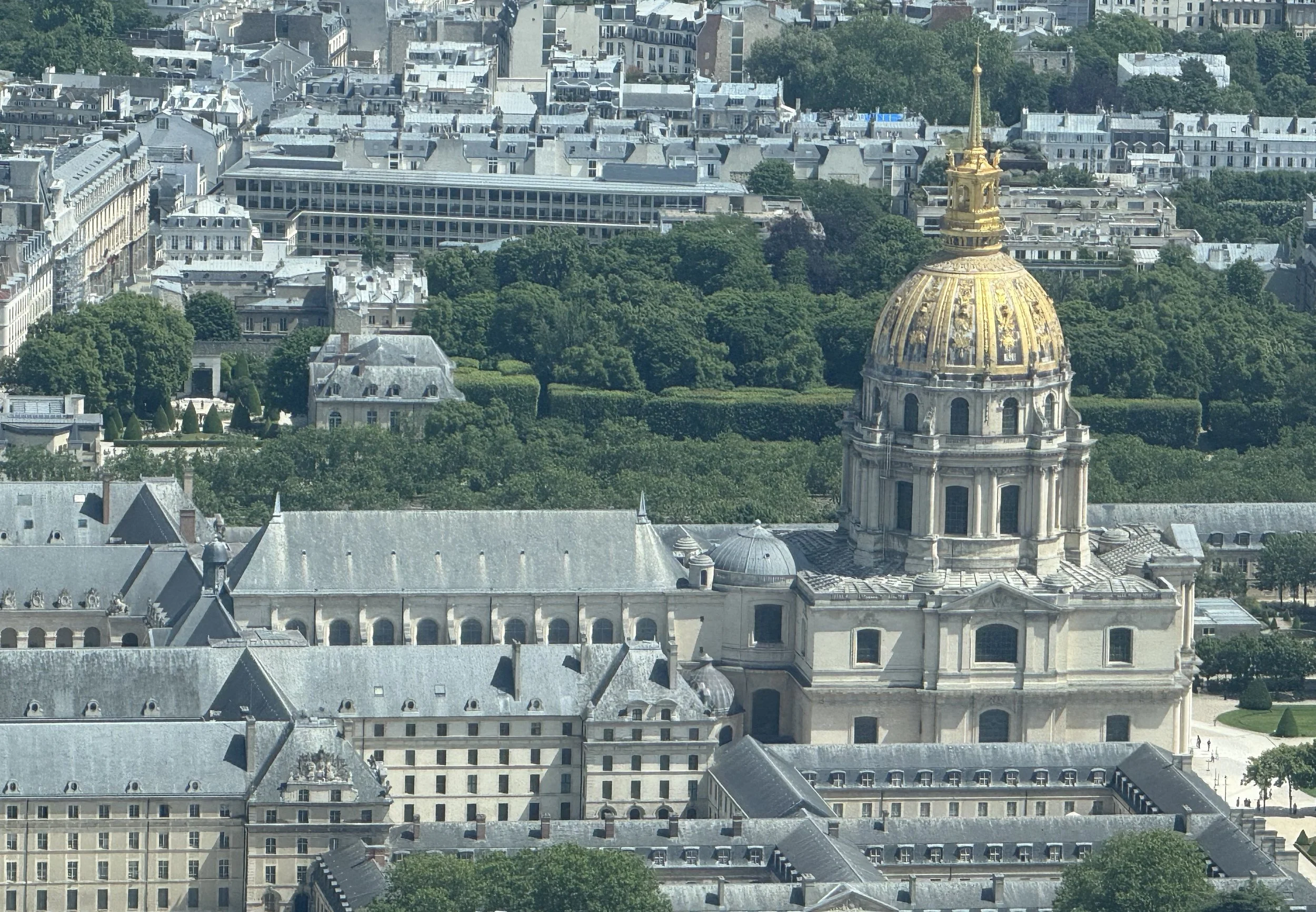
From the Eiffel Tower, I took a photo almost without thinking—one gleaming gold dome standing apart from the endless gray rooftops around it. Then the roofer in me started asking the usual questions. What is that? And more to the point: what is it made of?
That golden crown belongs to the Dôme des Invalides, in the 7th arrondissement, just across the river. Commissioned by Louis XIV in the 1670s as part of a home and hospital for aged and wounded soldiers, the domed church was later turned into a military memorial. Beneath that dome lies the tomb of Napoleon Bonaparte, which is what draws most visitors through the doors. But the dome itself—107 meters, or 351 feet, at its peak—is the part that stops you from across the city.
We've walked a few Paris rooftops together on this blog: the copper domes of the Institut de France and the Palais Garnier, and the natural slate dome of the Petit Palais. The Invalides brings all of it together in one roof.
A gilded roof over lead, copper, and a forest of oak
Look closer and the engineering is as impressive as the gold. The dome you see is a metal covering—principally lead, with copper as well—laid over a massive frame of oak. Not a modest frame, either: it took more than 6,000 individual pieces of timber to build, a structure the French fittingly call a "forest." Underneath that timber outer dome sit two stone cupolas that carry the real load. The gold leaf itself covers the dome's ribs, its twelve decorated compartments, the sculpted trophies, and the tall lantern crowning the top.
And because gold leaf over metal fights the same weather every roof fights, the French have regilded it several times across the centuries, most recently in 1989 for the bicentenary of the French Revolution—roughly 12 kilograms of gold, applied by hand as some half a million paper-thin leaves.
The lesson under the gold
There's an honest reminder in that dome for anyone who works on roofs. Even here, the elements get a vote: where the oak frame sits in direct contact with the lead, starved of air, the wood can rot—the same battle between materials and moisture we manage on every historic roof. You can crown a roof in gold, and it still has to be maintained, assessed, and renewed on a rhythm, generation after generation. That's why the great historic roofs of the world aren't installed once and forgotten. They're cared for, evaluated, and renewed in every era—which is exactly why this one has shined over Paris for three centuries.
It's the same principle we bring to the slate and copper roofs here at home. A historic roof is not a one-time purchase—it's a long relationship. Catch the small things early, renew what's reached the end of its service, and a well-built roof will outlast everyone who ever stood on it.
One more thing worth noticing
It's easy to miss with all that gold pulling your eye. Look past the dome at the sea of rooftops stretching across the frame. The vast majority of what you're seeing is natural slate. In Paris, and across much of Europe, slate is simply what roofs are made of—it's as ordinary and expected there as asphalt shingles are here in America. What we treat as a premium, specialty roof in the States is the everyday standard on the other side of the Atlantic. There's a whole city's worth of slate in a single snapshot, quietly doing its job for a century or more, while the gold dome gets all the attention.
If you own a historic slate, copper, or tile roof and you're wondering where yours stands, that's exactly the kind of evaluation we love to help with.
Sources & further reading
Musée de l'Armée (official site): The Dôme des Invalides & Napoleon's Tomb
Bibliothèque nationale de France – Passerelles: Une couverture de plomb, de zinc et d'or
Wikipedia: Les Invalides