
A Copper Spire Above Paris: The American Cathedral from the Eiffel Tower
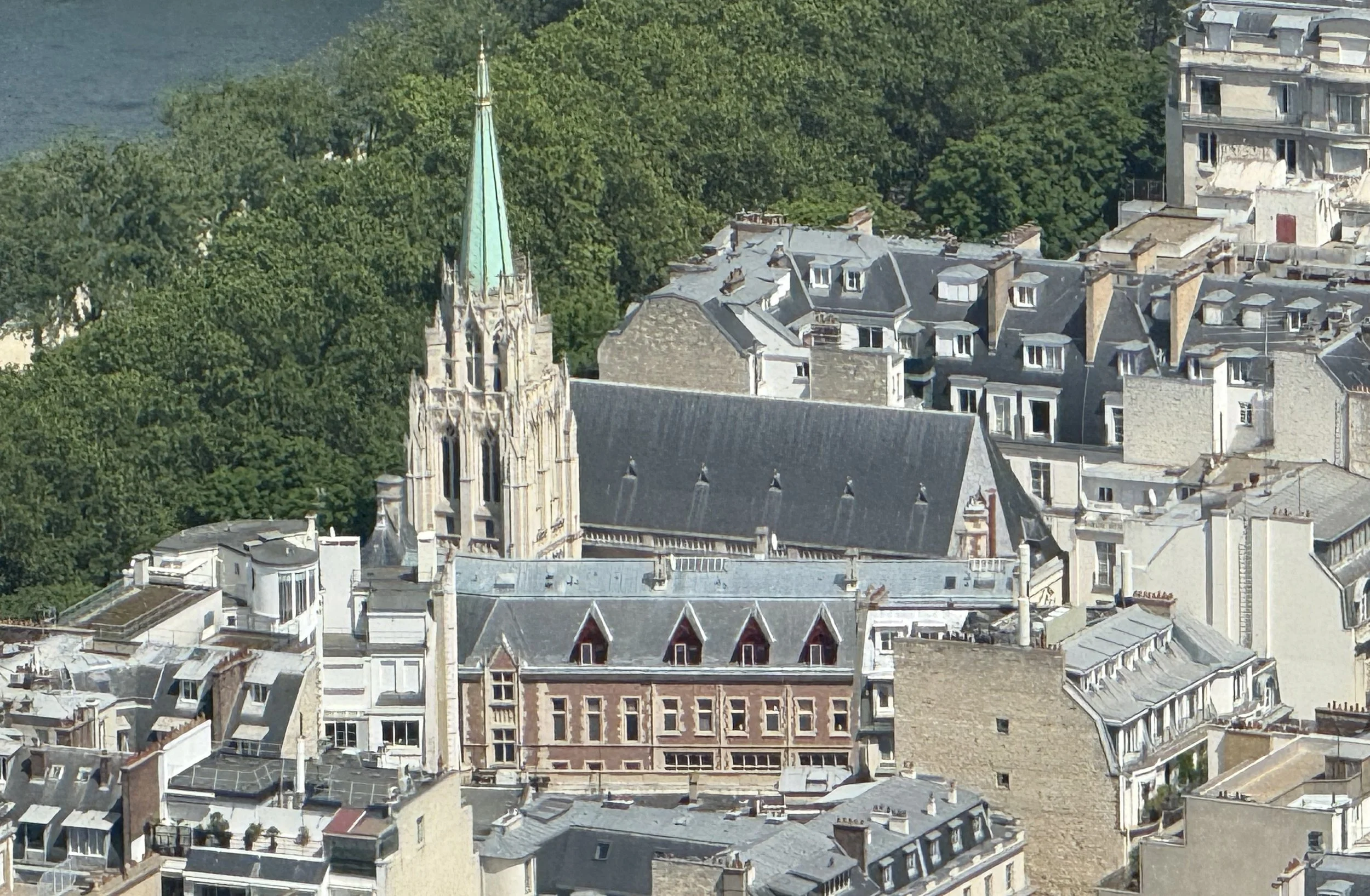
Green copper spire and slate nave roof on a Cathedral in Paris, seen from the Eiffel Tower
One green spire in a sea of gray
Most people go up the Eiffel Tower for the big picture: the Seine, the Arc de Triomphe, Sacré-Cœur on the horizon. I went up for the roofs.
From that height, Paris is a patchwork of zinc, slate, stone, and terracotta chimney pots. Almost all of it is gray. So when I looked across the river toward the 8th arrondissement and saw a tall, pale green spire rising out of the trees, my camera came up right away.
That spire belongs to the American Cathedral in Paris. In one frame, it shows three of the materials we work with every day at Carolina Slate: copper, natural slate, and the metal details that tie them together.
What you're looking at: the American Cathedral in Paris
The American Cathedral of the Holy Trinity stands at 23 Avenue George V, a short walk from the Champs-Élysées. American Episcopalians have worshipped together in Paris since the 1830s, and this building has been their home since 1886.
The English architect George Edmund Street, one of the leading Gothic Revival designers of his day, drew the plans in December 1880. He died a year later, just as work was getting underway. His son, Arthur Street, and fellow architect Arthur Blomfield saw it through, and a builder from Wolverhampton, England, carried out the construction between 1881 and 1886.
The tower is the showpiece. Its stone base is carved with tall lancet openings and pinnacles, and the spire above it rises to about 84 meters (276 feet). The cathedral describes it as the tallest spire in Paris.
In the photo you can see the whole composition at once: the carved stone tower, the green spire, and the long, steep nave roof running off to the right.
The copper spire: why it turned green
New copper is bright and penny-colored. It does not stay that way. Within months it darkens to brown, and over many years of rain, air, and sun it develops the soft blue-green coating you see on this spire. That coating is called patina, or verdigris.
Patina is not rust, and it is not a sign of neglect. It is a thin, stable layer that forms on the surface and shields the metal underneath from further weathering. It is the reason copper has been trusted on spires, domes, and steeples for centuries.
Look closely at the spire in the photo and you can pick out thin vertical lines running from base to tip. Those are the seams where the copper panels are joined. On a tall, tapered spire like this one, the seams carry water straight down and off the roof, and they let the metal expand and contract with the seasons without tearing.
If you followed my earlier posts on the copper domes of the Institut de France and the Palais Garnier, you will recognize the color. Every one of these roofs tells you its age at a glance.
The slate nave roof and its tiny vents
Behind the tower, the nave is covered by a long, steep roof of dark gray slate. A Gothic Revival church is built tall and narrow, and a steep pitch like this sheds rain and snow quickly. That steepness is also part of the design: it pulls the eye upward toward the spire.
The faint streaks running down the slope are normal weathering. Natural slate holds its color and strength for generations. A well-laid slate roof can outlast the people who installed it many times over.
Now look for the small, pointed openings set in a row along the slope. In France these are called outeaux: tiny triangular vents that let air move through the attic space under the roof. Air movement keeps the timber frame dry and helps the whole roof last longer. It is a small detail, but it is exactly the kind of thing that gets lost when an old roof is repaired by someone who does not understand why it was there.
The neighbors: zinc, mansards, and chimney pots
The rest of the photo is classic Paris. The pale, silvery roofs on the apartment buildings are zinc, the metal that gives the Paris skyline its famous blue-gray look. Many of them are mansards: a steep lower slope lined with dormer windows, topped by a much flatter upper roof. I wrote about this roof form in my post on Place Vendôme.
In the foreground, a brick building with a row of steep, pointed dormers sits right in front of the cathedral. Its gables echo the Gothic shapes of the church behind it. And everywhere you look there are clusters of small terracotta chimney pots, called mitrons, sitting on top of the old masonry chimneys.
Together they show something I love about Paris. Copper, slate, zinc, brick, and stone sit shoulder to shoulder, and each one was chosen because it suited the building it covers.
What this Paris rooftop teaches us about North Carolina roofs
The same Gothic Revival style that shaped the American Cathedral was built across North Carolina in the late 1800s and early 1900s. Many of our historic churches pair a slate roof with copper flashing, gutters, finials, or a copper-clad steeple, just like this one. Here is what we take from it.
Patina is a good thing on a spire, but age still matters at the joints. A green copper surface is doing its job. The weak points on an old copper roof are the seams, valleys, and flashing where copper meets slate or masonry. When copper flashing on a historic building has reached that age, it has usually come to the end of its life. Soldering old copper is unreliable, so full replacement with new copper is the lasting fix, not a patch.
Slate is usually worth saving. Natural slate can last well beyond a century. When a slate roof leaks, the cause is often a few broken slates, failed flashing, or rusted nails, not the slate itself. We start every project with a repair-first approach and a detailed condition assessment, so original material stays on the roof wherever it can.
Small details carry big weight. Vents, flashing, and seam patterns all exist for a reason. Ricardo has spent his career learning those reasons, so a repair works with the original design instead of against it.
From Paris back home
Standing at the top of the Eiffel Tower, it struck me that this spire has been weathering in the open air for nearly 140 years, and it still looks right. That is what good materials, installed with care, can do.
If your church, home, or historic building has a slate, copper, or clay tile roof, it deserves the same kind of care. Carolina Slate LLC restores historic roofs across North Carolina and Georgia. Contact us to schedule a condition assessment with Ricardo.