
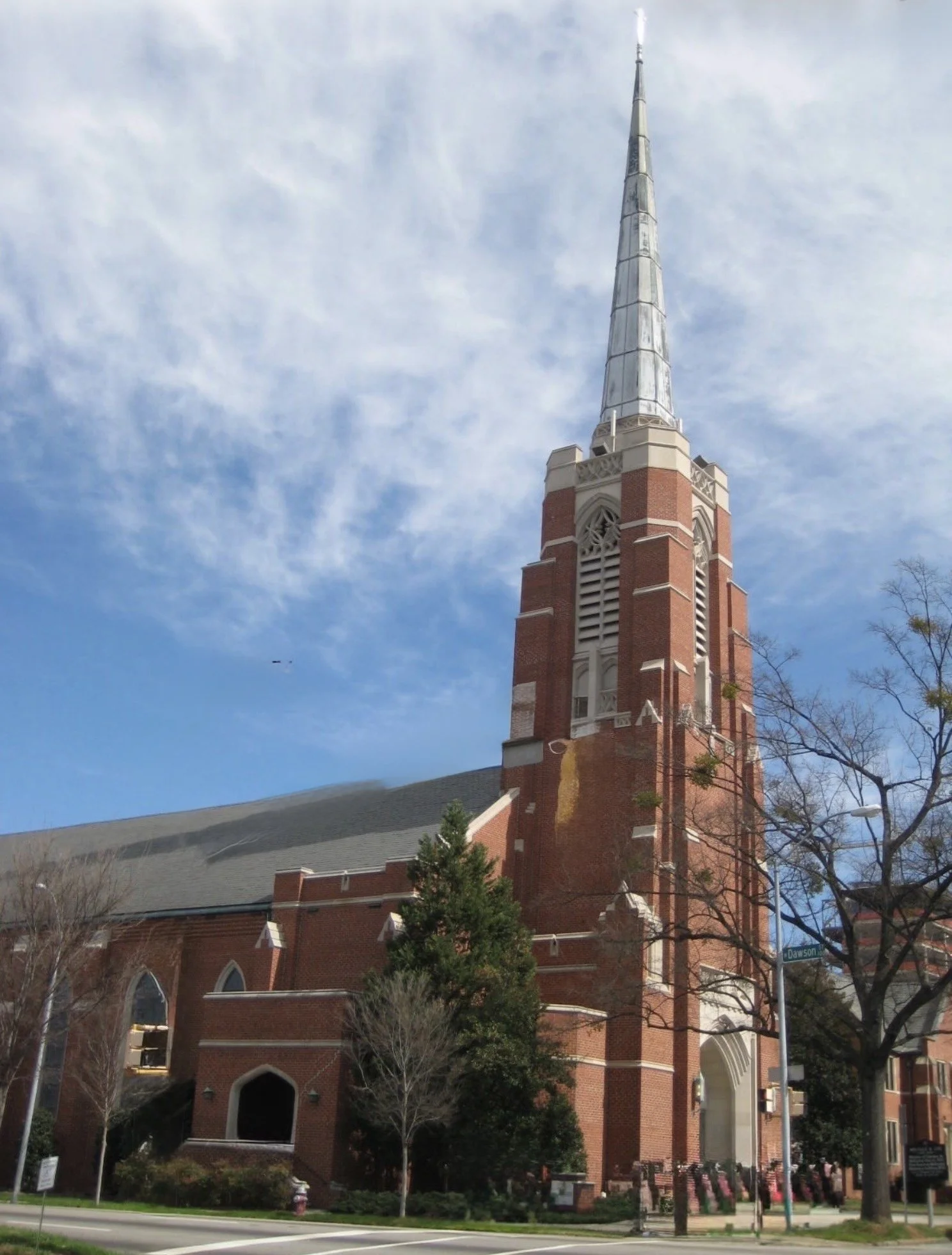
Edenton Street United Methodist Church-Raleigh, NC
Standing at the highest point in downtown Raleigh, on the corner of Dawson and Edenton Streets, Edenton Street United Methodist Church has been a defining landmark of this city since its founding in 1811. From its first humble structure built of hewn logs, the church has occupied four different buildings over its lifetime — two of which were lost to fire — yet each time it rose again from the same ground, rebuilt with the same enduring resolve. The current red-brick Neo-Gothic structure was completed in 1958, and today the congregation numbers more than four thousand members, carrying on a tradition that earned it the distinction of being known as the mother church of Methodism in North Carolina. A structure with this kind of history deserves nothing less than the highest standard of care — and that is exactly what Carolina Slate LLC brings to every project. We were honored to perform slate roof repairs on this iconic building, and while the scope of any repair may vary, no job is too small when it comes to preserving a roof of this significance. Slate has long been the material of choice for the world's most revered and sacred buildings — chosen not for convenience, but for its unmatched durability, its natural beauty, and its ability to endure for well over a century when properly maintained. A neglected slate roof, however, can deteriorate rapidly, and even minor issues left unaddressed can compromise the integrity of the entire structure. At Carolina Slate LLC, we understand that maintaining a slate roof isn't just routine upkeep — it's an act of preservation, ensuring that landmarks like Edenton Street United Methodist Church continue to stand tall for generations still to come.
Natural Slate Roofs Last a Century: Proven Durability & Historic Value
Natural slate is a type of metamorphic rock that has been used in roofing for centuries. Its longevity is one of its defining features.
Unlike modern roofing materials, slate stands up to UV exposure, moisture, and extreme temperatures without deteriorating. It’s naturally resistant to rot, insects, and fire, which is why many historic buildings still retain their original slate roofs today. In restoration projects, slate isn’t chosen simply for its durability—it’s restored because it’s already there, often performing well after 100 years or more. With regular maintenance, most aging slate roofs don’t need full replacement—just expert care to preserve their longevity and historic value.
For detailed information on slate sourcing, quality grades, color and thickness options, and common roofing layouts, visit our Slate Roofing Resource page.
Slate Roofing in Raleigh, NC
Raleigh's historic neighborhoods, landmark churches, and custom-built homes represent some of the finest slate roofing in North Carolina. Carolina Slate LLC provides expert slate roof repair, restoration, and assessment services across Raleigh and Wake County — with the experience to work on everything from century-old residential roofs in Oakwood to institutional landmarks in the heart of downtown.
Historic Preservation Requirements for Slate Roofs in Raleigh, NC
In Raleigh, maintaining or restoring a slate roof on a historic property involves coordinating with several key organizations responsible for historic preservation standards. These agencies ensure that repairs, replacements, or alterations preserve the city’s rich architectural heritage.
Local Oversight: Raleigh Historic Development Commission (RHDC)
The Raleigh Historic Development Commission (RHDC) is responsible for reviewing changes to properties within Raleigh’s local historic districts and to individually designated landmarks. This includes work on slate roofs, which often requires a Certificate of Appropriateness (COA) prior to any exterior work.
🔗 RHDC Overview
🔗 COA Guidelines and Application
🔗 Map of Raleigh Historic Districts and Landmarks
🌐 State-Level Support: North Carolina State Historic Preservation Office (SHPO)
If your Raleigh property is listed on the National Register of Historic Places, you may need to coordinate with the North Carolina State Historic Preservation Office (SHPO). SHPO provides technical support and reviews for work that may qualify for state or federal historic tax credits—including slate roofing restoration using traditional methods and materials.
🔗 NC SHPO Official Website
🔗 National Register Search Tool (NC)
Statewide Preservation Support: Preservation North Carolina
Preservation North Carolina (PNC) is a statewide nonprofit that helps protect endangered historic properties. Though not based in Raleigh, they provide valuable technical resources, advocacy, and guidance for owners restoring materials like slate on historic homes and buildings.
🔗 Preservation North Carolina
🔗 Resources for Property Owners
Planning a Slate Roof Project on a Historic Property in Raleigh
Check if your property is in a local historic district or individually landmarked by visiting the RHDC Map
Apply for a Certificate of Appropriateness (COA) before beginning any exterior work on the slate roof
Coordinate with SHPO if your property is nationally designated or if you're applying for tax credits
Consult resources from Preservation NC for support on materials, restoration practices, and available funding
By working with these trusted preservation agencies, your slate roof restoration project in Raleigh can meet required standards while preserving the architectural legacy that defines the city's character.
↓
Slate Roof FAQs: Raleigh & Wake County
Does Raleigh require a permit or approval before repairing a slate roof on a historic property?
It depends on your property's designation. If your home or building is located within one of Raleigh's local historic districts — such as Oakwood, Mordecai, or Hayes Barton — or is a city-designated landmark, the Raleigh Historic Development Commission (RHDC) requires a Certificate of Appropriateness (COA) before any visible exterior work begins, including slate roof repair or replacement. For properties listed on the National Register of Historic Places, the NC State Historic Preservation Office (SHPO) may also need to review the project, particularly if historic tax credits are involved.
I live in the Oakwood Historic District. Can I replace missing slate with a different material?
Generally, no — not without RHDC approval, and approval is unlikely for a full material substitution on a contributing structure. Oakwood is one of Raleigh's most closely regulated historic districts, and the RHDC expects repairs to match the original material, color, and profile as closely as possible. In most cases, the right answer is sourcing matching natural slate rather than switching to synthetic or composite material. We work with salvaged and new-quarried slate to find close matches for historic Raleigh roofs.
How do Raleigh's freeze-thaw winters affect a slate roof differently than other roofing materials?
Raleigh sits in a mixed climate zone where temperatures fluctuate enough to create freeze-thaw cycles, especially in January and February. Natural slate handles this better than most materials — it has very low water absorption, so it doesn't expand and crack the way porous materials do. Soft slates (certain grades of Virginia or Southern slate) are more vulnerable to freeze-thaw damage over time than hard slate varieties like Vermont or Pennsylvania slate. After a hard winter, it's worth having your roof evaluated to check for any slates that have softened, delaminated, or shifted at the fasteners.
The NC State Capitol has a slate roof. What type of slate is typically used on Raleigh's historic public buildings?
The NC State Capitol and several of Raleigh's older institutional buildings were originally roofed with domestic slate — primarily from Virginia and Pennsylvania quarries that were active in the 19th and early 20th centuries. These slates ranged from blue-gray to blue-black unfading varieties. For restoration work on comparable Raleigh properties today, we typically source from the same regional quarry traditions, matching color, thickness, and texture as closely as possible to the original material.
What's the difference between a slate roof evaluation and a full slate roof replacement, and how do I know which one I need?
Most Raleigh slate roofs — especially those on homes built before 1940 — don't need full replacement. They need targeted repair. A roof evaluation identifies which individual slates are cracked, slipped, or missing; checks the condition of the flashing and valley work; and assesses whether the fasteners (typically copper or stainless) are still holding. From there, we give you a clear picture of what can be repaired and extended versus what may be nearing the end of its serviceable life. Replacement is typically the right call only when the majority of slates are failing and the underlayment has deteriorated beyond repair.
I have a slate roof in Hayes Barton. How do I find out if my property is in a historic district before calling for an evaluation?
You can check your property's status using the RHDC's online map tool, available through the City of Raleigh's website. Hayes Barton is a designated Raleigh historic district, but not every property within its general boundaries is necessarily a contributing structure. The RHDC map will show you exactly where your parcel falls.
Can you match the slate color on my Raleigh home if only a few pieces need replacement?
Often, yes — though it depends on the original slate type and how much it has weathered. Raleigh homes from the early-to-mid 20th century were typically roofed with semi-weathering gray-black or blue-gray slate, which weathers to a softer tone over decades. We assess the existing roof visually and, when possible, use salvaged slate from similar-era roofs to achieve a close match. On prominent street-facing slopes in historic districts, a close match matters both aesthetically and for RHDC compliance.
What happens to slate flashing over time, and is it something I should have evaluated separately from the slate itself?
Yes — flashing is often where Raleigh slate roofs fail first, even when the slate itself is still in good condition. Original flashing on older Raleigh homes was typically lead, galvanized steel or copper. Over time, galvanized flashing corrodes, lead & copper flashing can crack or lift at the seams. We use copper for all new flashing work, which outlasts the alternatives significantly. If your roof is leaking but the slate appears intact, failed valley or chimney flashing is usually the first place we look.
Do Raleigh churches with historic slate roofs face different repair considerations than residential properties?
Yes, in a few ways. Church roofs in Raleigh — including those in the downtown core and older neighborhoods — tend to have steeper pitches, larger surface areas, and more complex detailing around steeples, dormers, and decorative ridgelines. Original copper flashing and gutters on these buildings have typically reached the end of their serviceable life and require full replacement rather than repair. Soldering aged copper is unreliable and rarely holds long-term, so we don't patch what needs to be replaced. We use copper for all new flashing and gutter work, which is both the historically appropriate choice and the most durable one. Access and staging on church buildings also require more planning than a typical residential project. We have experience working on historic church roofs across North Carolina and understand the care and coordination these projects require, including working with church leadership and any applicable preservation oversight.