
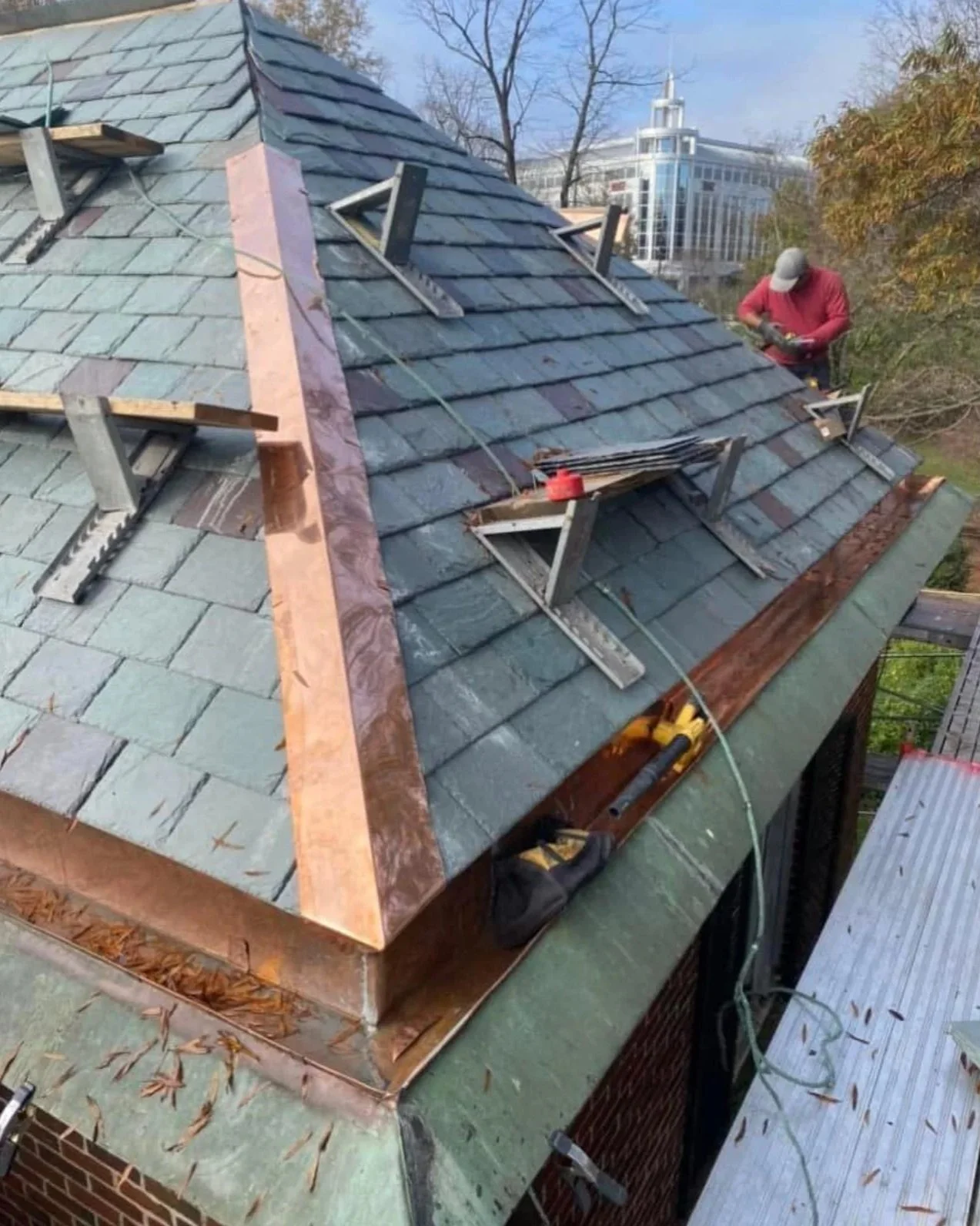
Natural Slate Material
Slate Roof Repair & Restoration
in Chapel Hill, NC
Preserving Chapel Hill's Rooftop Heritage
Chapel Hill is home to some of North Carolina's most architecturally significant buildings — from Federal and Classical Revival homes along Franklin Street to the nation's oldest public university campus. Many of these structures were built with natural slate roofs meant to last a century or more, and with proper care, they still can.Carolina Slate specializes in diagnosing, repairing, and fully restoring natural slate roofs on historic properties in Chapel Hill, Carrboro, Hillsborough, and surrounding Orange County. Whether you own a contributing property within a local historic district, a church with a century-old slate system, or a residential home with aging slate, we have the skills and materials to restore it faithfully.We use salvaged and new slate, copper flashings, and traditional installation methods that satisfy historic preservation standards.
What We Do -
Slate Roofing Services in Chapel Hill, NC
Slate Roof Repair
Broken, slipped, or missing slates repaired using matching salvaged or new material. We preserve your existing roof system whenever repair is the right choice — and we'll tell you honestly when it is.
Historic Church Roofing
Specialized restoration of slate, clay tile, and copper roofing on chapel and church structures. We understand the unique structural and aesthetic demands of ecclesiastical buildings.
Residential Historic Homes
Careful assessment and restoration of slate roofs on historic residences in Chapel Hill's Franklin-Rosemary, Cameron-McCauley, and Gimghoul historic districts.
Copper Flashings & Gutters
All flashing, valleys, ridge caps, and built-in gutters executed in copper — the only metal we trust on a slate roof. Proper copper work is essential to slate longevity.
Roof Reports
Written reports suitable for historic preservation applications, real estate transactions, insurance claims, and COA submissions to Chapel Hill's Historic District Commission.
Chapel Hill Historic Districts & Landmark Rules
If your property is located within one of Chapel Hill's local historic districts — or is individually designated as a local historic landmark — any exterior roofing work may require a Certificate of Appropriateness (COA) from the Chapel Hill Historic District Commission before work begins.
Established 1976-Franklin-Rosemary Local Historic District
Chapel Hill's first local historic district, covering the historic commercial and residential core along Franklin and Rosemary Streets. Overlaps with the National Register district and requires COA approval for all exterior changes.
Established 1990-Cameron-McCauley Local Historic District
A significant residential historic district on the west side of Chapel Hill. The West Chapel Hill National Register district was established in 1998 and generally overlays this local district.
Established 1993-Gimghoul Local Historic District
A unique residential area with both local and National Register historic district status, anchored by Gimghoul Castle. COA requirements apply to all properties within the boundary.
National Register 1971-Chapel Hill (UNC) Historic District
Covers 46+ contributing buildings on the UNC campus and surrounding areas, including the Chapel of the Cross, Old East, Playmakers Theatre, and other structures dating from 1793 to the early 20th century.
National Register 1994-Old Chapel Hill Cemetery
Listed on the National Register of Historic Places. Historic structures and associated buildings within or adjacent to this resource may carry preservation obligations.
Orange County-Hillsborough Historic District
The Hillsborough Downtown Historic District on the National Register of Historic Places features more than 100 historic homes, buildings, and churches from the 18th and 19th centuries — many with original slate roofs.
Certificates of Appropriateness
Under Chapel Hill's Land Use Management Ordinance (Section 3.6.2), any project that affects the exterior appearance of a property within a local historic district — including roof repairs, re-roofing, and flashing replacement — requires a COA regardless of whether the building is individually historic. Roof repairs and small-scale projects may qualify for staff-level approval rather than a full Commission hearing.
COA applications are due the first Friday of the month prior to the Historic District Commission's monthly meeting. The current application fee for a combined COA and Zoning Compliance Permit is $570 — check the Town of Chapel Hill's Overlay Districts page for current pricing. Applications are submitted online through the Town of Chapel Hill's permit portal.
Who to Contact
Historic Preservation Contacts for Chapel Hill
If you own a historic property and aren't sure about your obligations before re-roofing, the following organizations can help you understand what approvals you need.
Town of Chapel Hill-Historic District Commission (HDC)
Reviews COA applications for all properties within Chapel Hill's three local historic districts. Meets monthly; nine-member volunteer commission appointed by Town Council.Phone: 919-969-5077↗ HDC Information & Applications↗ Submit a COA Application Online
Non-Profit / Local-Preservation Chapel Hill (PCH)
The leading local preservation advocacy organization. PCH manages the Horace Williams House, operates a historic plaque program, and is a key resource for property owners seeking guidance on restoration standards.↗ preservationchapelhill.org
State of NC-NC State Historic Preservation Office (SHPO)
Administers the National Register of Historic Places nominations for North Carolina and manages the state historic tax credit program. Consult SHPO for properties of statewide or national significance. CLG / Commission Questions: kristi.brantley@dncr.nc.gov
or 919-623-2412↗ hpo.nc.gov
Statewide Non-Profit-Preservation North Carolina
Statewide nonprofit that protects and promotes significant historic structures across NC, including many in the Chapel Hill-Orange County area. Offers guidance on historic tax credits and restoration standards.↗ presnc.org
UNC-Chapel Hill-UNC Facilities Planning — Campus Preservation
For work on or adjacent to UNC campus buildings, coordinate with UNC's Campus Historic Preservation Manager in the Facilities Planning Department, who oversees the Carolina Historic Preservation Survey.↗ UNC Facilities & Campus Operations
Federal-National Park Service — National Register
For properties listed on the National Register of Historic Places, the NPS provides guidance on the Secretary of the Interior's Standards for Rehabilitation — the national benchmark for historic roofing restoration.↗ NPS Historic Preservation
100+ Year Lifespan
Properly installed and maintained natural slate can outlast any synthetic alternative and will meet the long-term expectations of historic preservation standards.
Fireproof & Non-Absorbent
Slate is naturally fire-resistant and practically non-absorbent, making it the highest-performance roofing material available for historic structures.
Required for Historic Compliance
Chapel Hill's Design Principles & Standards require that replacement materials match the historic character of the roof — which for most pre-1950 buildings means natural slate.
Eligible for Historic Tax Credits
Qualifying restoration work on National Register properties may be eligible for NC state and federal historic tax credits, partially offsetting the cost of a proper slate restoration.
Salvaged Slate Available
We maintain a network of salvaged slate sources to match existing roofs in color, thickness, and texture — essential when repairing a contributing historic structure.
Eco-Friendly & Sustainable
Natural slate is quarried stone with zero synthetic content. A well-maintained slate roof may never need to be replaced, making it one of the most sustainable roofing choices possible.