
The Art of Fish-Scale Slate Roofing
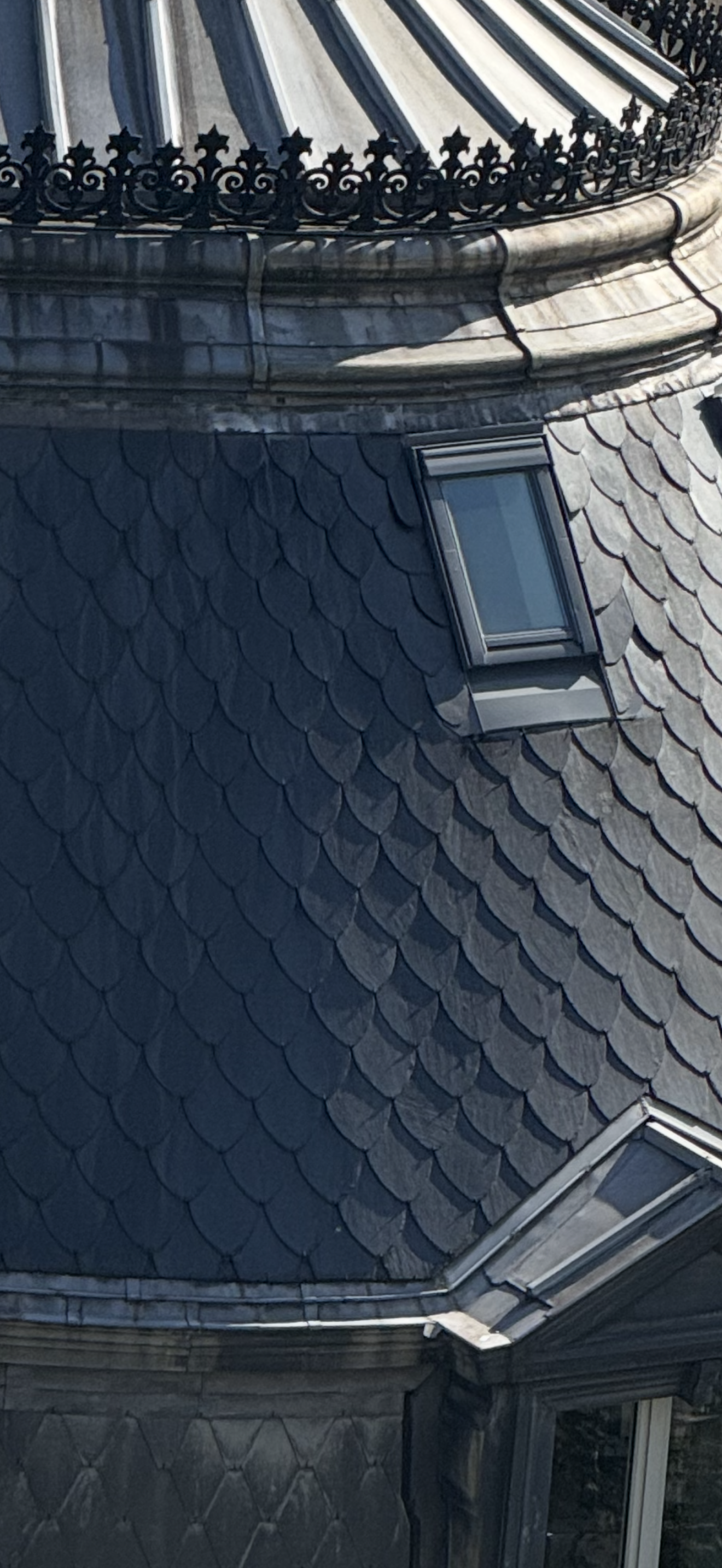
Fish scale slate roof
Fish-Scale Slate on a Paris Turret
Look up almost anywhere in Paris and the rooftops become their own skyline a layered world of slate, zinc, and iron that most people walk beneath without ever noticing. This turret stopped me. A curved wall of fish-scale slate, a ribbed metal crown, and a run of cast-iron cresting fine enough to be jewelry. Everything in this photograph is the work of hands, and most of it is older than any of us.
The scales are the engineering
The slate wrapping the round tower is cut in what we call a fish-scale or scalloped pattern each piece rounded at the exposed butt so the courses read like the overlapping scales of a fish. (Or a dragon, if you ask my granddaughters.) It looks ornamental, and it is beautiful, but the shape is doing real work. On a curved or conical surface, a narrow slate with a rounded bottom can bend gently around the tower course after course without gapping or buckling the way a wide, square-cut slate would. The pattern isn't decoration laid over the engineering. The pattern is the engineering.
Roofing a cone is hard
A turret gives a roofer nothing flat to work from. Every course sits at a slightly smaller diameter than the one below it, so each ring of slate has to be sized and spaced to close that geometry as it climbs. Done well as it clearly is here the eye never catches a seam. The scales simply tighten as they rise toward the crown. Done poorly, a curved slate roof telegraphs every miscalculation. This is craftsmanship measured in patience, and there's no shortcut for it.
Where slate stops, metal begins
Above the slate, the little dome is clad in ribbed metal in Paris, almost always zinc capped with that band of ornate cast-iron cresting along the cornice. This is the classic French collaboration: slate does the broad, weather-shedding work down the walls of the roof, and metal takes the tight curves, ridges, and ornaments where slate can't easily go. You'll see the same logic on the city's grand domes, where the field is slate and the crown, ridges, and finials are metal.
Lower on the roof, the darker lines running down the hips and valleys are flashing, doing the quiet and essential job of channeling water off a complicated shape. On historic buildings, this metalwork is usually the first thing to reach the end of its life. When we find aged copper on an old roofline back home, it has typically served its full run and needs full replacement rather than a patch soldering tired copper rarely holds. The slate itself can easily outlast two or three generations of the metal around it.
A modern window, woven in
Notice the roof window set flush into the slate. Someone brought daylight into that room without breaking the historic surface the courses run right up to a clean metal surround and carry on. That's exactly the balance we aim for on older roofs: modern function integrated so carefully that the original still looks like itself.
You don't have to fly to Paris for this
The same fish-scale slate, the same graduated courses, the same copper and metalwork show up on towers, turrets, and steeples across the Carolinas and Georgia the churches, courthouses, and grand old homes built back when slate was simply how you covered something you meant to keep. When those roofs need attention, our instinct is always to repair and restore before we replace. A well-laid slate roof is a hundred-year decision. Our job is to honor the century it already has and add to it.
So the next time you travel or even when you're just walking your own downtown look up. The best roofs were built to be admired from below, and most of them still are.