
A Belle Époque Crown: The Domes and Golden Gate of the Petit Palais
Photo and blog written by Maribel.
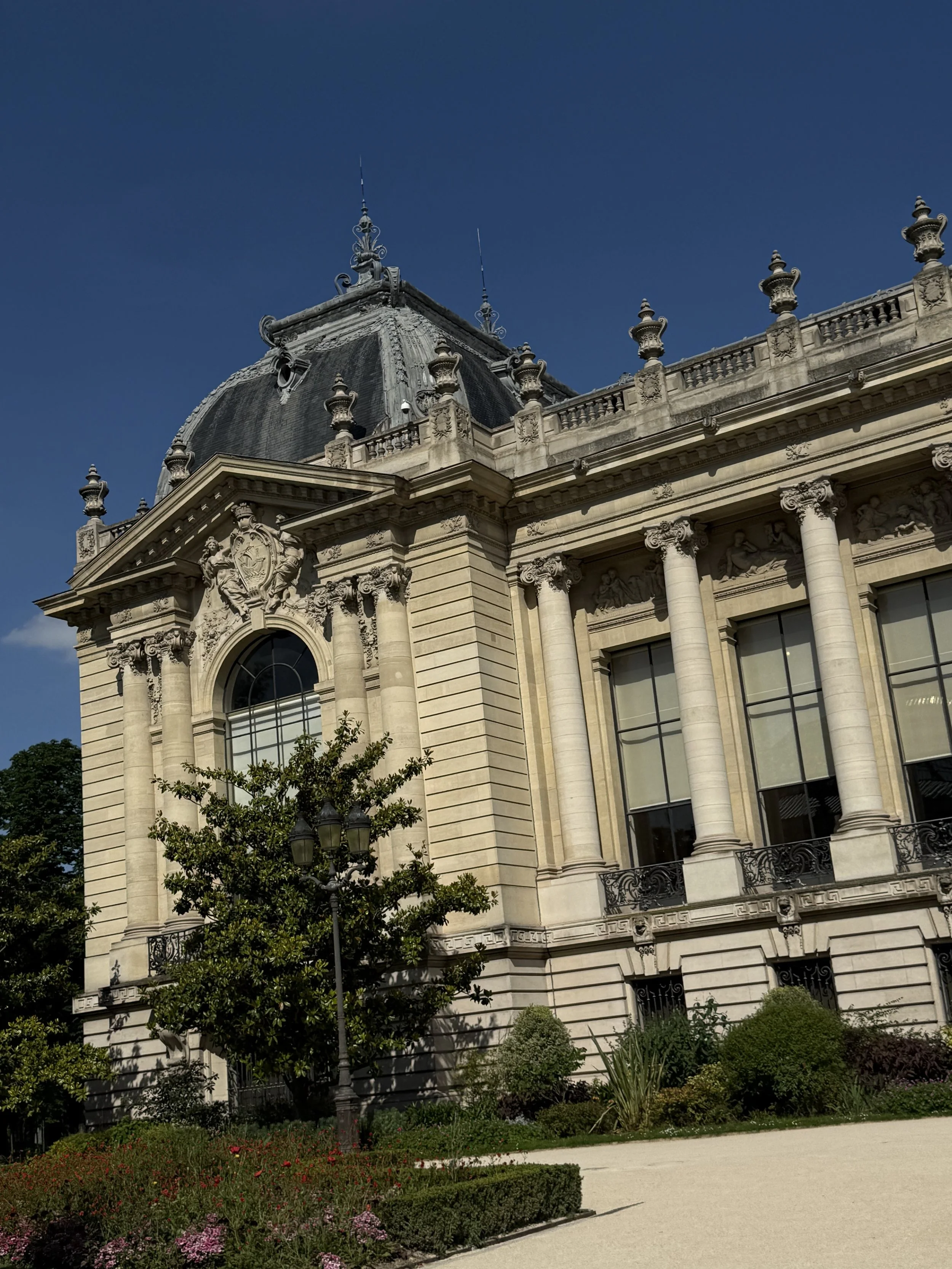
Historical slate
The Petit Palais is crowned with slate — the very material we work in every day — and its dazzling golden entrance gate is a masterwork of wrought iron. The moment I saw it, I understood why it stopped me: the same spirit that runs through all of our work is written all over this place. A love of craftsmanship overhead, and a belief that the crown of a building deserves as much artistry as anything inside it. It was far too beautiful not to share.
A Palace Built for a World's Fair
The Petit Palais was built for the 1900 Exposition Universelle, the great World's Fair that also gave Paris the Grand Palais across the avenue and the Pont Alexandre III over the Seine. Construction began in 1897 and was completed in 1900, and in 1902 the building became the Musée des Beaux-Arts de la Ville de Paris, the city's fine arts museum, which it remains today.
Its architect was Charles Girault, who shaped the palace as four wings arranged around a semi-circular garden and peristyle, in the grand Beaux-Arts style. High above the main pediment floats a carved ship, the emblem of Paris, with the city's motto, Fluctuat nec mergitur, which means "rocked by the waves, it does not sink." It is a fitting phrase for a building meant to endure.
The Domes That Crown It
What drew my eye first, of course, were the domes. Rising above the pale colonnade, the Petit Palais is crowned by slate domes that give the building its unmistakable silhouette against the Paris sky. Above the main entrance sits a graceful cupola, and the corner pavilions carry their own smaller domes, each ringed by a stone balustrade lined with carved urns.
Look closely and you can see exactly how these domes are built. The broad field of each dome is a slate roof, natural slate laid in tight courses that follow the curve. Only the ridges, edges, cresting, and fine detailing are picked out in metal, framing and accenting the slate rather than covering it. That pairing is a hallmark of fine European roofing: the slate carries the water beautifully across the sweep of the dome, and the metal handles the ridges, hips, and ornament where slate cannot be shaped.
What makes it especially handsome is that the entire field is laid in a single, uniform slate color, so the whole curve of the dome reads as one clean, continuous surface. That consistency is not luck. On a curved roof, any variation in shade shows instantly from the ground, so a single-tone field means the slate was carefully sorted and blended by hand. The result is that soft, even gray that weathers so gracefully against the pale limestone.
A dome is one of the most demanding shapes a roofer can face. Every slate has to be cut and set to follow a curve that changes as it rises, and the work has to stay watertight while remaining beautiful from the street far below. When you see a slate dome that has held its shape, its color, and its dignity for more than a century, you are looking at craftsmanship of a very high order. That is exactly the kind of work we love, whether it is a slate dome, a slate turret, a copper dome, or the curved detailing where a roof meets a tower.
The Golden Gate: Metal as Art
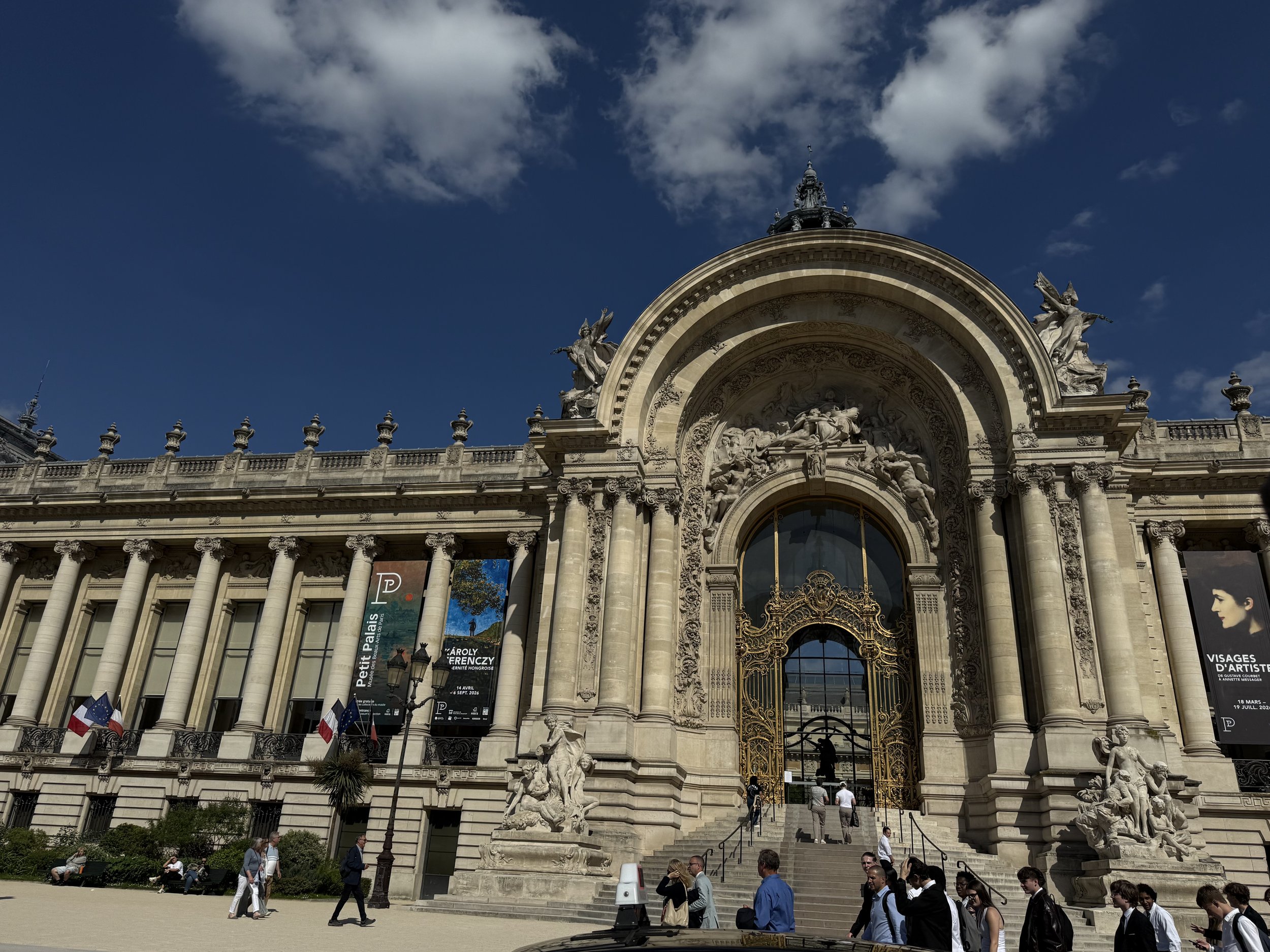
The gilded entrance grille of the Petit Palais
I have to pause on that gate. The gilded entrance grille of the Petit Palais was designed by Girault himself and is considered one of the finest works of wrought iron anywhere in Paris. Its floral design is all flowing Art Nouveau curves, with tendrils that seem to grow right out of the metal, and it was praised from the day it was unveiled for the sheer virtuosity of its craftsmanship.
Now, wrought iron is not our trade. We shape copper, we lay slate, we set clay tile. But standing in front of that gate, I felt the same admiration I feel watching a skilled metalworker hand-form a copper gutter or a piece of flashing on one of our own projects. There is something remarkable about taking a material as hard and unforgiving as metal and coaxing it into something that looks delicate, alive, and effortless. That is the heart of metalwork, whether it is a golden gate in Paris or a copper roof in North Carolina, and it never happens by accident. It happens through patient, expert hands.
Built to Last, and to Be Seen
Girault designed the Petit Palais so that its most beautiful spaces were the ones visitors would pass through most often, the entrances, the staircase beneath the dome, the garden peristyle. He wanted the building itself to be a work of art, not just a container for one. More than 125 years later, it still is, carefully preserved and welcoming over a million visitors a year.
That instinct to build for permanence and beauty, and then to protect what you have built, is exactly what guides our approach to historic roofs. A roof done right in the right material is not a thing you replace every decade. It is part of the building's identity, meant to be admired and maintained for generations.
The Craft Overhead in the Carolinas
You do not need a World's Fair to appreciate a beautiful roof. Across North Carolina, historic homes, churches, and civic buildings wear domes, turrets, slate roofs, and copper details that carry the same devotion to craft on display at the Petit Palais.
At Carolina Slate, natural slate, Ludowici clay tile, and copper are our materials, and beauty built to last is our goal. Ricardo brings more than three decades of hands-on experience to every project, with the same respect for craftsmanship and history that keeps a Belle Époque palace glowing beside the Seine. If you have a historic property, a dome, or a slate or copper roof in North Carolina that deserves that kind of care, we would love to talk. And wherever you find yourself, do not forget to look up.
Carolina Slate — natural slate, Ludowici clay tile, and copper roofing specialists serving North Carolina.