
When the Roof Is the Story — Notre-Dame Cathedral of Reims
What an 800-Year-Old Cathedral Teaches Us About Why Roofs Matter
This past May, I had the privilege of standing before one of the most extraordinary buildings in the world — Notre-Dame Cathedral of Reims, in the heart of the Champagne region of France. With my own camera in hand, I walked every angle of this cathedral — outside along its sculpted facades, and inside beneath its soaring Gothic vaults. What I saw stopped me in my tracks, not just as a visitor, but as someone who has spent over 30 years caring for historic roofs.
Because at Reims, the roof is not just a roof. It is a testament to everything we believe about preservation, craftsmanship, and what it means to protect something worth keeping.
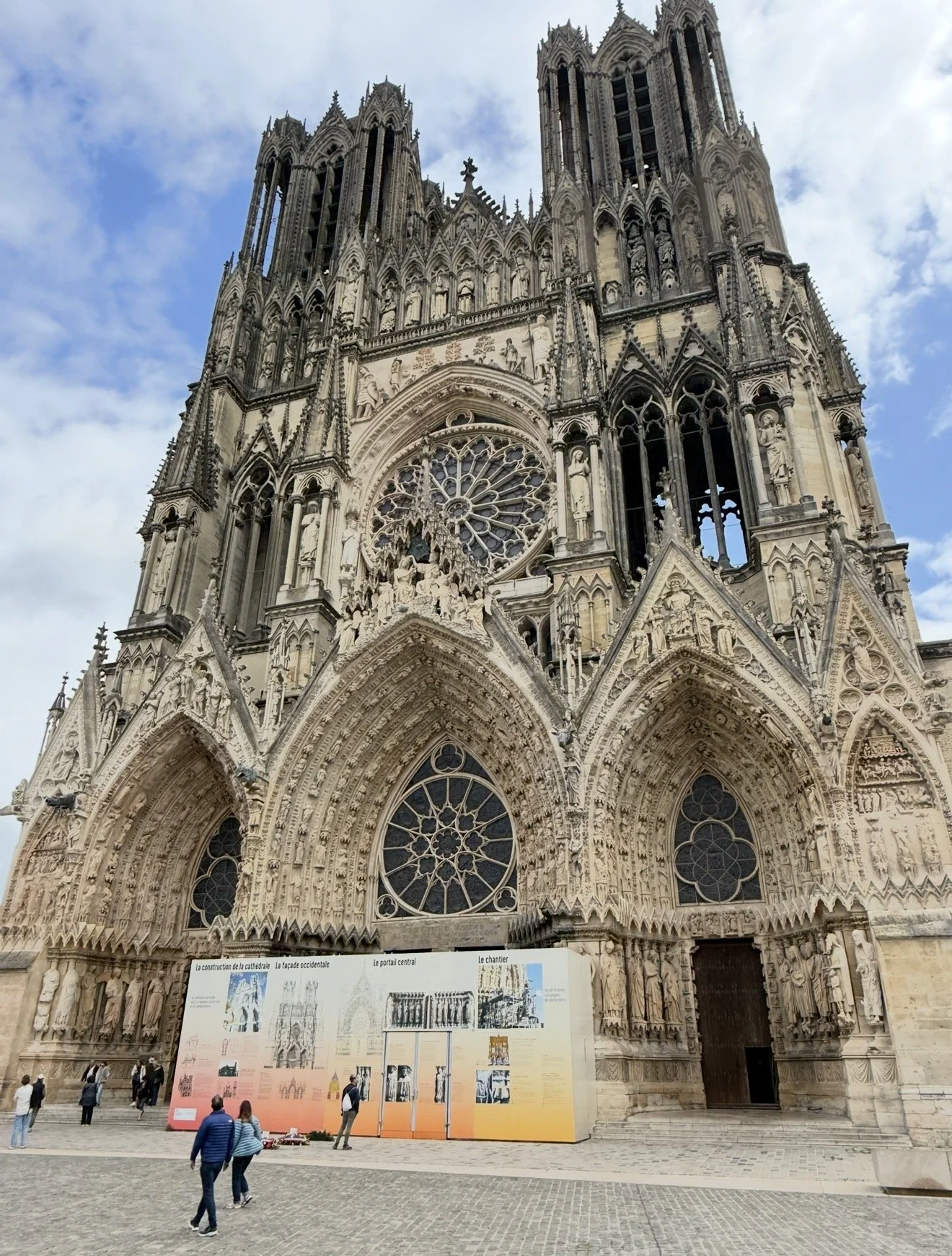
Reims Paris Cathedral
A Cathedral Over 800 Years in the Making
Notre-Dame de Reims is a Roman Catholic cathedral dedicated to the Virgin Mary and is famous for being the traditional location for the coronation of the kings of France. Construction began in 1211, and this magnificent structure served as the place where French kings were crowned and anointed for centuries. The last coronation held here was that of Charles X in 1825 — making this building not just a house of worship, but a throne room of an entire civilization. Structurae + 2
With a remarkable height of 272 feet and a nave length of 377 feet, Reims Cathedral showcases intricate stone carvings and stained glass windows that have survived fires, revolutions, and wars. Standing inside it, you feel the full weight of that history pressing down from above — beautiful, humbling, and immovable. EBSCO
The Roof: A History of Fire, War, and Resurrection
The roof of Reims Cathedral has endured more than most structures ever will — and it has been rebuilt more than once from near total destruction.
On July 24, 1481, a fire caused by the negligence of workers on the roof destroyed the framework, the central bell tower, and the galleries at the base of the roof, and caused the lead of the roof to melt, causing further damage. Thanks to financial backing from the royal crown, the work was able to continue — and as a gesture of gratitude, it was decided to decorate the roof with statuettes of the fleur-de-lis, a flower symbolic of the crown. StructuraePARISCityVISION
But nothing tested this cathedral — or its roof — like World War I. On September 18 and 19, 1914, German artillery shells hit the cathedral, setting fire to the scaffold around the towers. Lead from the burning roof poured through the mouths of the church's stone gargoyles, windows exploded, and the famous Smiling Angel statue near the front door lost its head. The cathedral ultimately took 300 direct hits from German artillery. Smithsonian MagazineTheviewfromchelsea
What happened next is one of the great preservation stories in history. After the war, a restoration project began in 1919, led by architect Henri Deneux. The Rockefeller Foundation provided significant funding for the repairs, and modern materials including reinforced concrete were used to make the structure stronger. The cathedral was reopened in 1938. As a result of Rockefeller's generosity, a street facing the cathedral's west facade was named after this American philanthropist. KiddleThe Metropolitan Museum of Art
The history of the Cathedral of Notre-Dame of Reims encompasses eight centuries of technical and artistic innovations, from the 13th century to its restoration after the First World War, which provided it with a remarkable reinforced concrete framework. UNESCO
What the Roof of Reims Tells Us About Material Choices
One of the most fascinating aspects of this cathedral for anyone in the roofing trade is the deliberate, centuries-long conversation about what to put on top of it. Lead was the material of choice for Gothic cathedrals across France — not because it was the easiest option, but because it was the most durable, weather-resistant, and workable material available for the complex shapes and steep pitches these buildings demanded.
The same principle applies to slate. Across Europe, and in the great historic buildings of the American South and Northeast, slate was chosen for the same reason — not convenience, but commitment. When you are building something meant to outlast generations, you choose a material that can do exactly that. Slate, like lead on the great cathedrals of France, is a promise made in stone.
Walking the exterior of Reims this May, looking up at the roof line against the French sky, I thought about every historic home and church I have worked on back home in North Carolina. The scale is different. The centuries are different. But the obligation is the same — to understand what you have, treat it with respect, and give it every chance to survive.
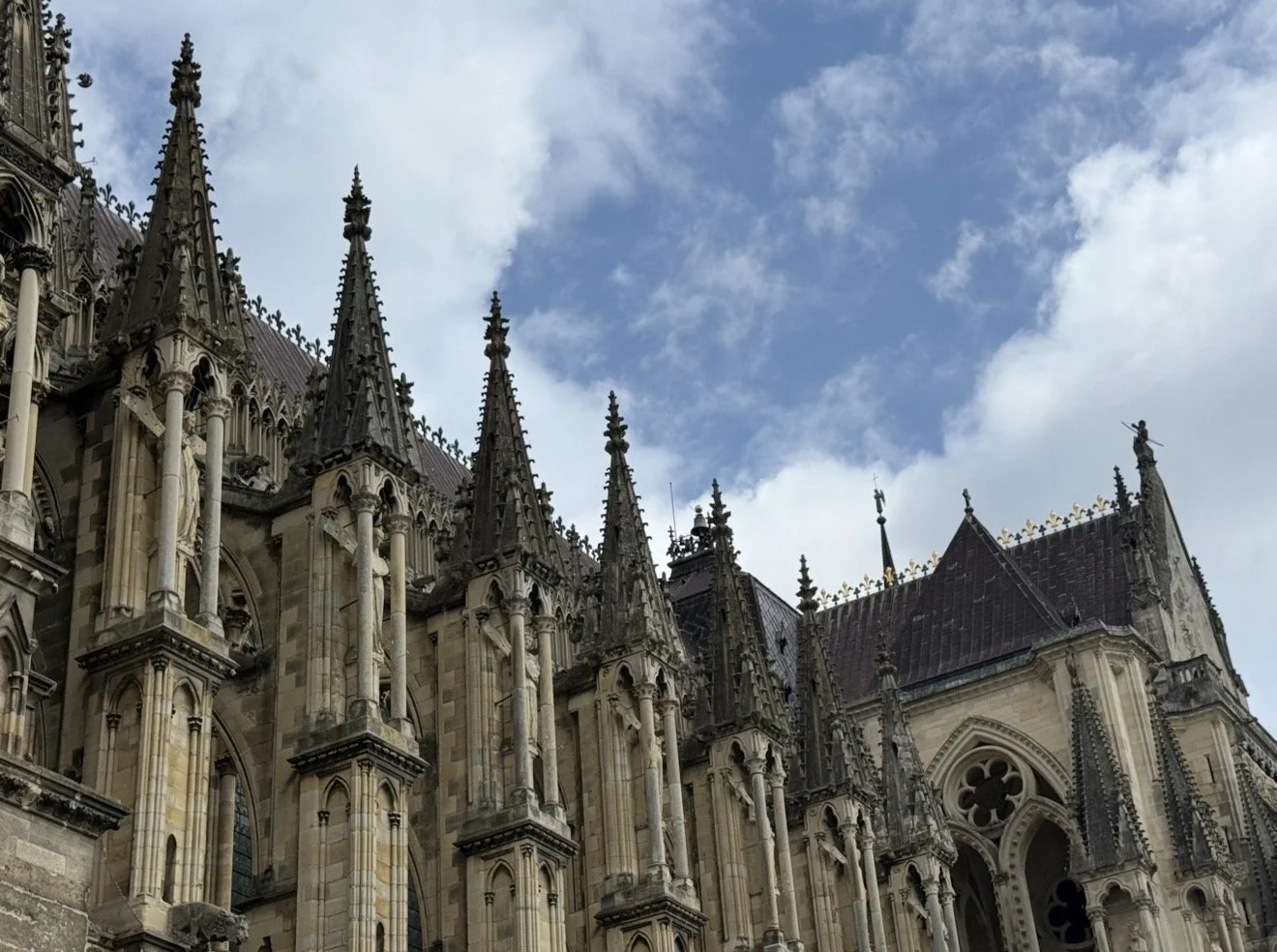
Reims Paris Cathedral
Why This Matters Closer to Home
You do not have to travel to France to stand beneath a roof worth preserving. Durham, Raleigh, Chapel Hill — the Triangle area is full of homes and buildings carrying roofs that have protected families and communities for a hundred years or more. Like Reims, they have weathered storms, been patched by well-meaning hands who did not always use the right materials, and sometimes been overlooked until a problem became impossible to ignore.
At Carolina Slate LLC, we carry the same conviction that drove the restorers of Reims: that what is worth building is worth protecting, and that the roof above it all is where that protection begins.
If you have a slate roof — on a home, a church, or a historic building anywhere in North Carolina or Georgia — we would be honored to take a look at it with the same eyes I brought to Reims this May.
Contact Carolina Slate LLC for an estimate. Because your roof has a story too.
All photos featured in this post were taken personally by the Carolina Slate LLC team during a visit to Notre-Dame Cathedral of Reims, France, May 2026.