
Sometimes the Smallest Roofs Tell the Biggest Stories
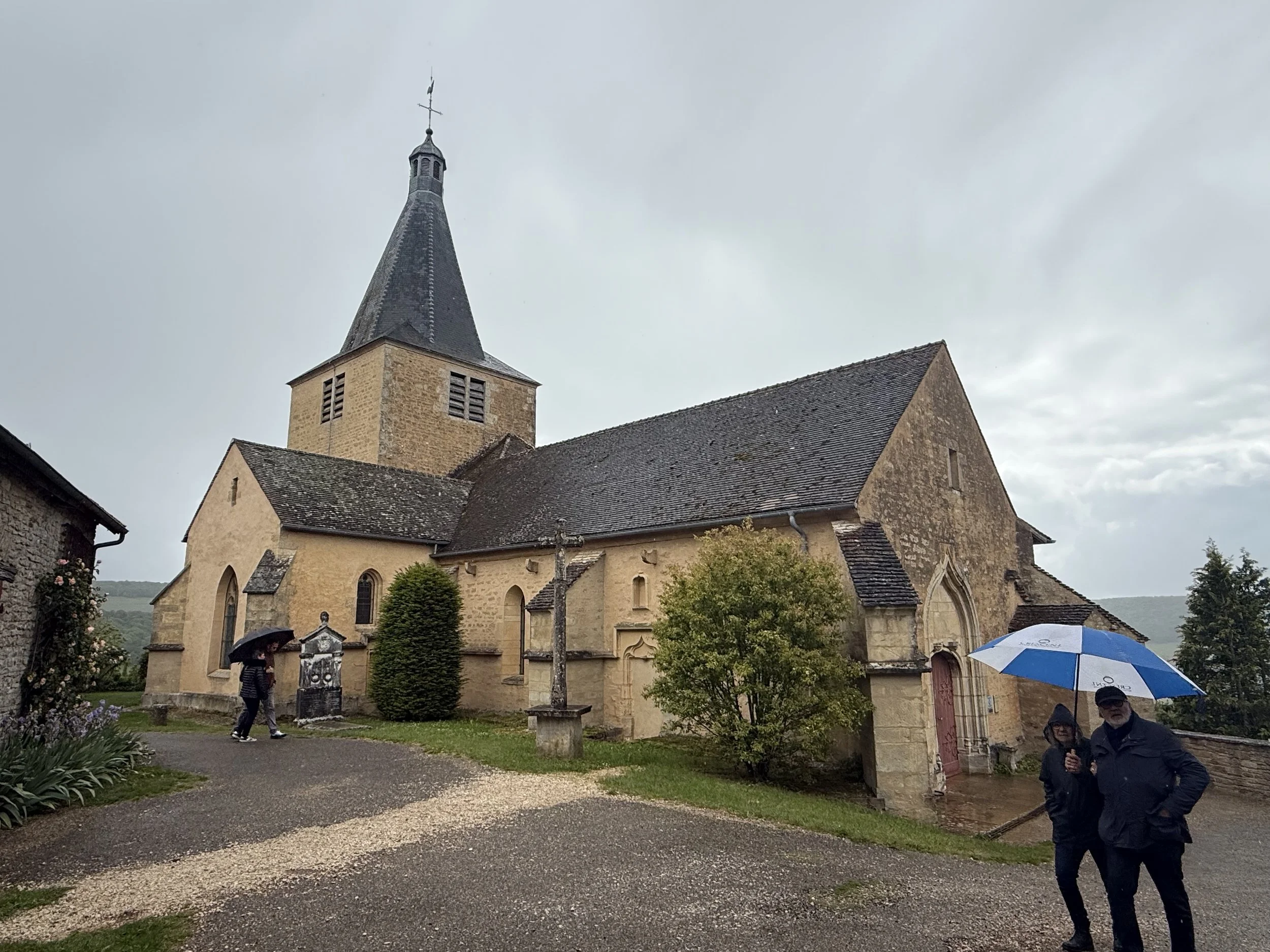
Not every memorable experience happens at a world-famous cathedral. Sometimes it happens on a quiet, rain-soaked afternoon in a medieval village perched on a rocky hilltop in Burgundy, France — population roughly 90 — where a 15th-century church stands at the end of a cobblestone lane, its stone roof glistening in the grey light, utterly unbothered by the passing of centuries. This past May, that is exactly where I found myself. And I would not trade it for anything.
The Village That Time Forgot to Disturb
Châteauneuf-en-Auxois is listed among the most beautiful villages in France, nestled at the foot of its imposing fortress which once belonged to the Dukes of Burgundy, positioned strategically between Dijon and Autun. The village sits on a rocky outcrop and can be seen from far away — from the A6 motorway below, from boats passing along the Burgundy Canal, and from the surrounding Auxois plain stretching out in every direction. France VoyageBourgogne Tourisme
The day I was there, rain had settled in over the valley. The stone streets were slick and dark. Tourists were scarce. And honestly — it was perfect. There is something about a medieval village in the rain that strips away every modern distraction and hands you the place as it actually is. Just stone, silence, and centuries.
I had my camera. I had nowhere to be. And at the end of the lane, the church was waiting.
The Church of Saint-Philippe and Saint-Jacques
The Church of Châteauneuf is placed under the patronage of Saint-Philippe and Saint-Jacques, and dates from the end of the 15th century and the beginning of the 16th century. Dedicated to St. Philip the Galilean and St. James the Greater — whose relics can be found in Santiago de Compostela — the church was for a long time a branch of the mother church in Vandenesse, where the Lords of Châteauneuf were buried as early as 1300. It was not until 1572 that it was established as its own parish. Bourgogne Tourisme
It is not a grand cathedral. It is not trying to be. What it is, is something rarer — a small, complete, nearly untouched piece of medieval Burgundian religious architecture that has stood in this village through the Hundred Years' War, the French Revolution, and two World Wars, quietly doing what it was built to do.
The church is shaped like a cross, oriented toward the east, with a single nave and two chapels on either side of the transept. On the white walls of the nave you can still see consecration crosses, as well as dark stains that are the remnants of an old funeral border — a painted band that once ran along the walls to honor the dead. Christaldesaintmarc
What Stopped Me — The Roof
As someone who has spent over 30 years working on historic roofs, I could not walk away from the exterior without spending real time looking up. And what I saw on that roof, wet and dark in the May rain, was exactly the kind of thing that reminds me why this work matters.
The massive bell tower, rebuilt in 1821, is covered in slate — topped by a small lantern tower said to have originally come from the village of Pommard. The slate on this church is not decorative. It is not a design choice made for aesthetics alone. It is the same practical, deeply considered decision that builders across France and Europe made for centuries when they needed a roof to last — not for a decade, not for a generation, but for as long as the walls beneath it could stand. Echo des Communes
Standing in the rain looking at that slate, I thought about the hands that laid it. About the storms it has shed. About the winters it has survived. A slate roof on a 15th-century church in a Burgundian village is not so different in principle from a slate roof on a 19th-century home in Durham or Raleigh, North Carolina. The material is the same. The obligation is the same. Protect what is underneath. Outlast everything else.
Inside — Where the Centuries Live
Stepping inside out of the rain, the church offered something extraordinary in its quietness. The furnishings inside are particularly rich — including a 14th-century Virgin and Child statue attributed to Jean de Marville, sculptor to the Dukes of Burgundy, and a 15th-century Saint John the Baptist by Guillaume Chandelier, who also created the tomb of Philippe Pot. Sauvegarde de l’Art Français
Two statues of Saint-Philippe and Saint-Jacques from the early 16th century have their own remarkable story — they were sold around 1872 to an antiques dealer, then acquired by an English lord who ultimately returned them to the church in 1913. They have been here ever since, back where they belong. Sauvegarde de l’Art Français
A miraculous Virgin statue, hidden away during the French Revolution, was returned to its place in 1831. The bells in the tower date to 1526 and 1583 — still hanging, still ringing, in a village of 90 people in the hills of Burgundy. Echo des Communes
Then — A Charcuterie Board and a Glass of Wine
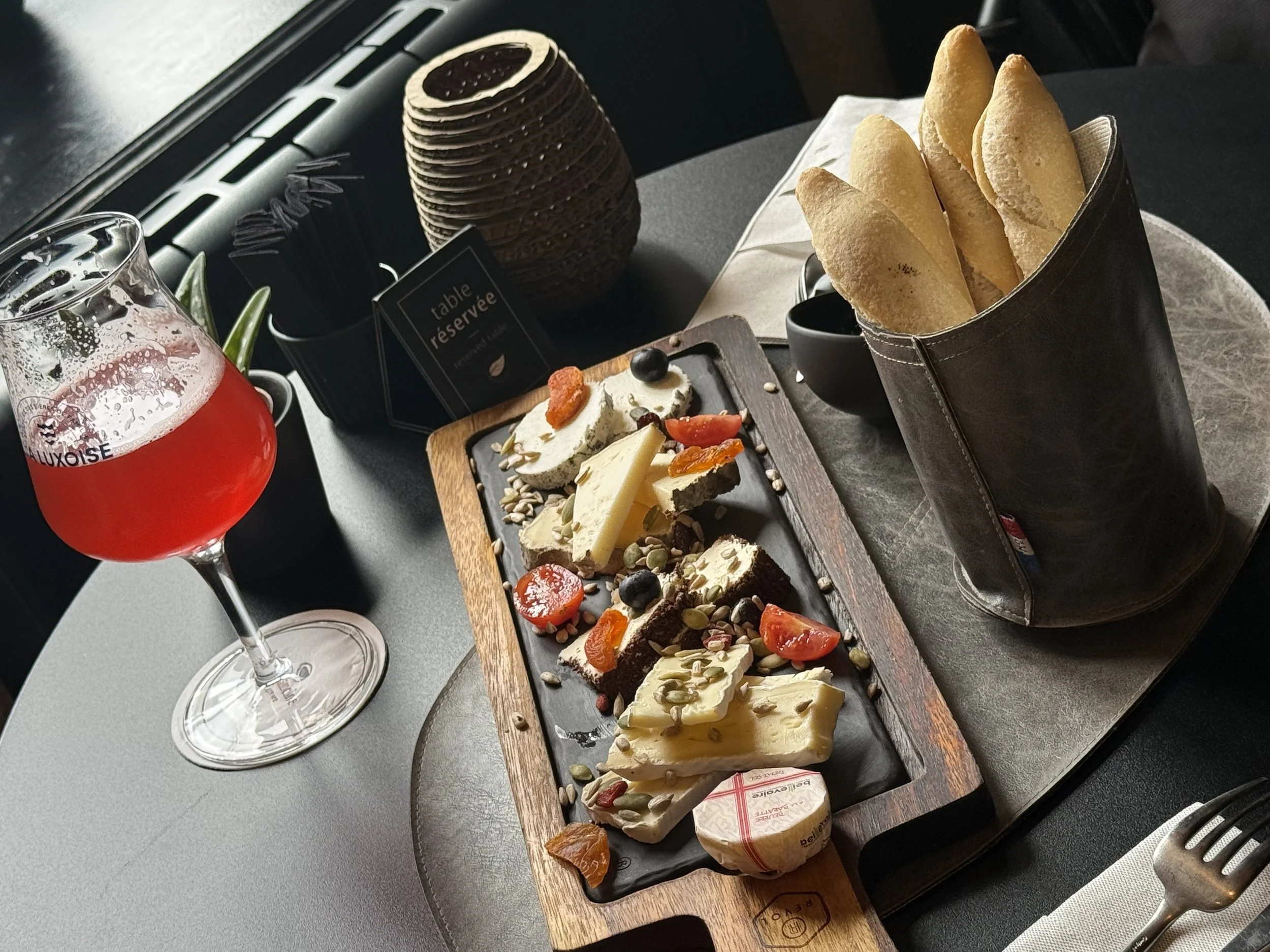
After the church, the rain had no intention of letting up. So I did what any reasonable person does in a medieval French village on a rainy afternoon — I found a local spot, sat down, and ordered a charcuterie board and a glass of Burgundy wine.
There is something deeply right about eating well in a place where people have been eating well for 600 years. The board arrived — cured meats, aged cheese, mustard, cornichons, fresh bread — and the wine was exactly what the moment called for. Outside, the rain tapped on the cobblestones. The castle loomed above the rooftops. And for a little while, the 21st century felt very far away.
These are the moments that remind you why old things are worth preserving. Not just the buildings. Not just the roofs. But the way of life that gathers beneath them.
What This Means Back Home
Every time I travel and stand before a building that has endured centuries, I come home a better craftsman. Not because I learned a new technique, but because I was reminded of the standard. These structures — the churches, the chapels, the manor houses — survived because someone, at every generation, cared enough to maintain them. To replace a tile before the water got in. To inspect the flashing before the damage spread. To treat the roof as what it truly is — the first and last line of defense for everything underneath.
At Carolina Slate LLC, that is the conviction we bring to every project. Whether it is a historic home in Trinity Park, a church in downtown Raleigh, or a property anywhere across North Carolina and Georgia — we treat your roof the way the builders of Châteauneuf treated theirs. As something worth doing right, and worth protecting for the long haul.
Contact Carolina Slate LLC today for an estimate. Your roof has a story — let us help it keep telling it.
All photos in this post were taken personally by the Carolina Slate LLC team during a visit to Châteauneuf-en-Auxois, Burgundy, France, May 2026.