
When a homeowner calls us about a leak on a slate roof, the slate is rarely the cause. Natural slate can last 100 years or more. The places where water gets in are almost always the places where the roof meets something else: a chimney, a brick wall, a dormer, or the low roof over a bay window.
Each of those joints moves with heat, cold, and settling, and water running down the roof has to get past it. Flashing is what bridges the joint. On a slate roof, proper flashing is built from parts that work together: step flashing, counter flashing, and, behind wider chimneys, a cricket.
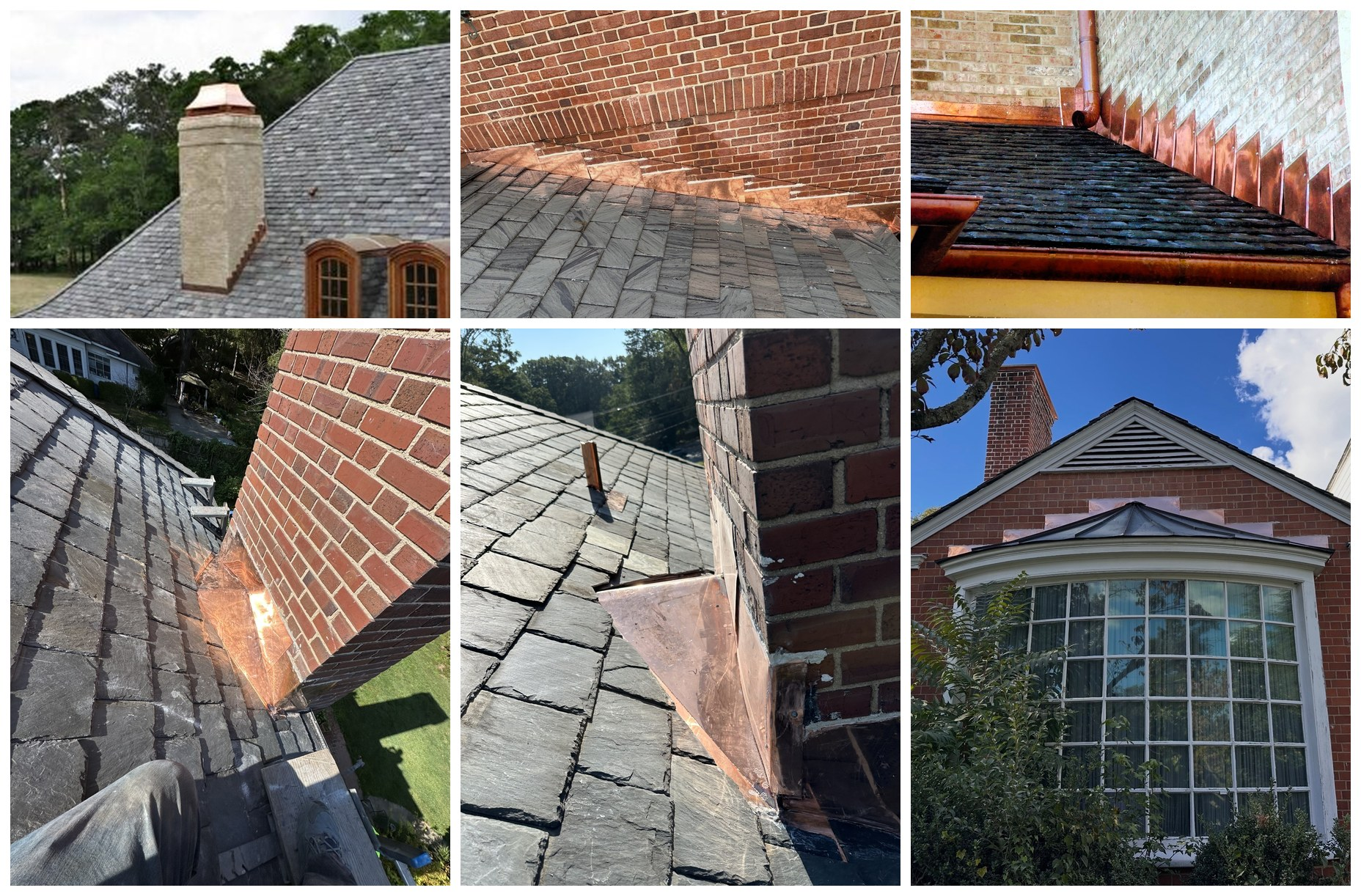
Copper flashing on slate roofs: a chimney with stepped counter flashing, step and counter flashing along brick walls, copper crickets behind chimneys, and counter flashing above a bay window roof.
Step Flashing: Woven Into the Slate
Along the side of a chimney, a brick wall, or a dormer, each course of slate gets its own piece of step flashing. Each piece is bent so one leg lies under the slate and the other turns up against the brick. The pieces overlap like the slate itself, stepping up the roof one course at a time.
Because every piece is tucked under a slate, water that reaches the wall runs onto the flashing and back out over the slate below. It never has a straight path into the roof. A single long strip of metal laid along the wall can't do this. Water gets behind it and follows it right into the house.
Counter Flashing: Set Into the Mortar
Step flashing covers the roof side of the joint. Counter flashing covers the top edge of the step flashing so water running down the face of the brick can't slip behind it.
Done right, the mortar joints are cut, the counter flashing is bent into the joint, and the joint is tuck-pointed closed. On a sloped roof, the counter flashing steps up the chimney or wall following the brick courses. That's the stair-step pattern of copper you see in our photos, along side walls and on the brick wall above a bay window roof.
What we often find instead is counter flashing caulked or tarred to the face of the brick. It may look fine for a season or two, but the sealant dries out, cracks, and pulls away, and water runs right behind it.
Crickets: Turning the Water Around the Chimney
On the uphill side of a chimney, water and debris run straight into the brick. On a narrow chimney, flashing alone can handle it. On a wider chimney, water, leaves, and in winter, ice, collect in that corner and sit against the joint.
A cricket, sometimes called a saddle, is a small peaked roof built behind the chimney. It splits the water and sends it around both sides instead of letting it pool. We build ours with copper, shaped to the chimney and tied into the step and counter flashing so all three parts work as one system.
Signs Your Flashing Needs Attention
Water stains on a ceiling or wall near a chimney, dormer, or bay window
Damp or stained brick or wood in the attic
Tar, caulk, or roof paint smeared where the roof meets brick
Loose, lifted, or missing metal along a chimney or wall
Cracked or missing mortar where the counter flashing is set
A flashing leak usually shows up inside long after it starts. By then, the wood decking and framing beneath may have begun to rot, and the repair grows from new flashing to wood repair first.
When Old Copper Has Done Its Job
Copper flashing on a historic home can last many decades, but it doesn't last forever. Once aged copper has thinned and cracked, it has usually reached the end of its life. Soldering patches onto old copper isn't reliable, so in most cases the right repair is new copper flashing, installed the right way.
Let Us Take a Look
If you've noticed a leak near a chimney, wall, or window, or you're not sure how your flashing was installed, we'd be glad to help. Ricardo has over 30 years of hands-on experience with slate and copper, and he'll give you an honest evaluation of what your roof needs and what it doesn't.
Contact Carolina Slate to schedule a flashing evaluation.