
The Roof That Bends: A Curved Slate Mansard on the Streets of Paris
Some roofs you notice from a moving car. This one stopped us on the sidewalk.
We were walking near Place Vendôme, on the corner of Rue Danielle Casanova, when we looked up — and there it was. A Parisian corner building, pale stone and wrought-iron balconies, wearing a slate roof that doesn't sit flat or straight anywhere. It rolls. It curves. It sweeps down and back up again in one continuous, unbroken line of slate, following the bow of the building beneath it as though the stone and the roof had been drawn with the same pencil.
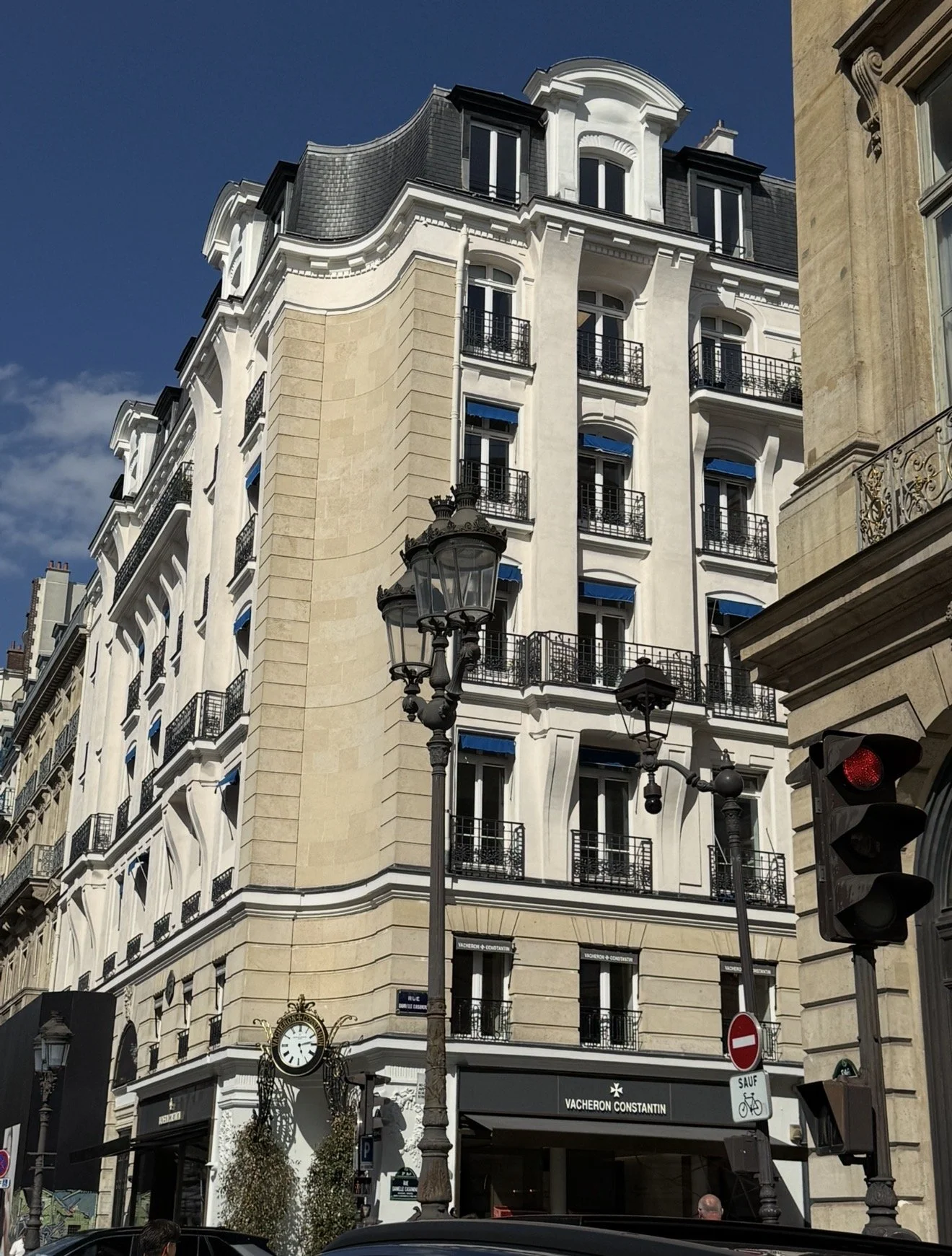
Mansard Roof - Full corner building, street view
We stood there a good while. People walked around us.
What You're Actually Looking At
This is a mansard roof — that steep, tall French roof form with living space tucked inside it, the one that gives the Paris skyline its unmistakable silhouette. But look closer at the top edge.
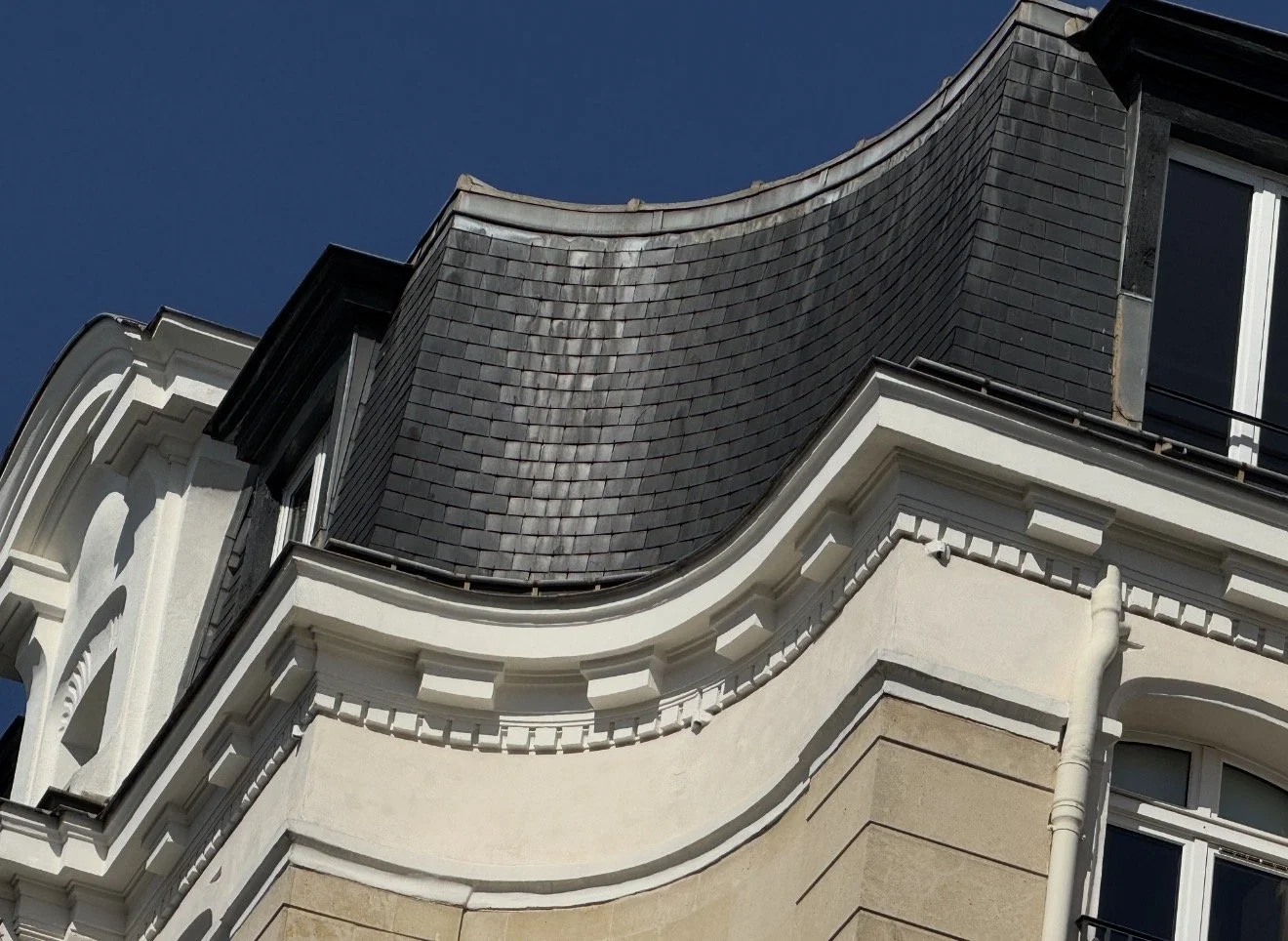
Close-up of the curved slate sweep
That upper portion doesn't meet the sky at a hard angle. It curves — a concave sweep, sometimes called a rolled or flared mansard — where the slate rolls back on itself before reaching the ridge. And it's not a small radius, either. That curve travels the entire rounded corner of the building, changing its pitch continuously the whole way around.
Now think about what that asks of the material and the roofer.
Slate is stone. It does not bend. Every one of those pieces is flat, rigid, and quarried from the earth — and yet the roof reads as a smooth, flowing curve. That illusion is created one slate at a time. As the pitch changes across the curve, the exposure has to change with it. The courses tighten. The headlap adjusts. Each slate is trimmed, sized, and set at a slightly different angle than the one before it, so that dozens of straight lines add up to something that looks effortlessly round.
There is no shortcut for this. No machine does it. It is done by hand, by someone who understands both the stone and the geometry, and who is willing to take the time.
The Details Nobody Was Meant to Notice
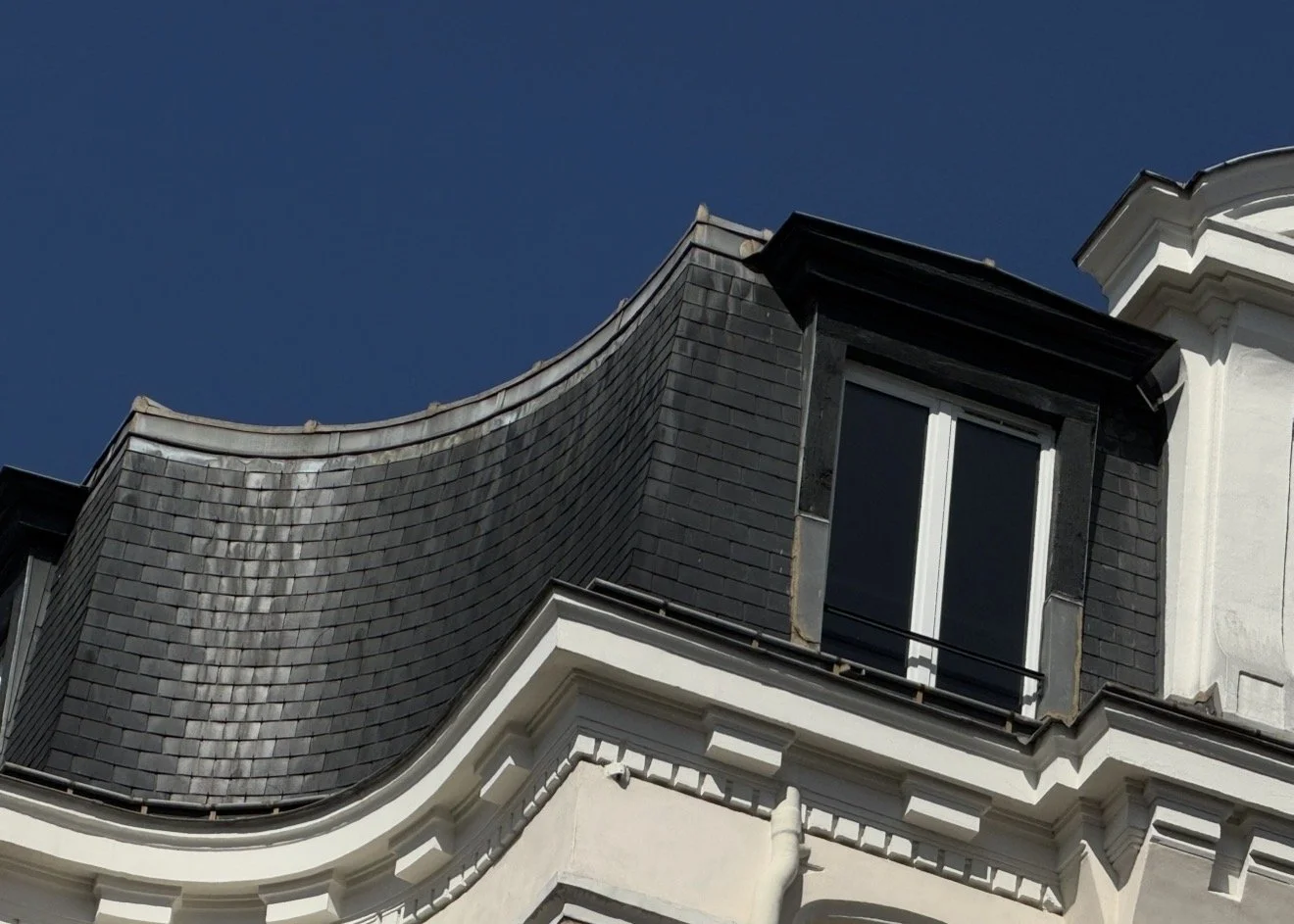
Curved slate with dormer detail
Look at where the dormer breaks through the curve. The roof is already bending in one direction, and now a window has to punch through it — which means the flashing has to be shaped to a surface that's curving and pitched and changing. Look at the way the metal work caps the ridge and wraps the edge, following that same sweeping line without a single awkward break.
These are the details that separate craft from installation. Nobody standing on Rue Danielle Casanova was ever supposed to notice them. They're just supposed to look up and think that's beautiful — and never know why.
That's the part we love. Good roofing disappears into the building it protects.
Why It's Still There
Here's the thing that keeps pulling us back to these Paris rooftops: this roof is old. Slate roofs of this kind have been standing over these streets for well over a century, through rain, freeze, thaw, wind, and generations of city life below.
And they're still working.
That's natural slate. It doesn't wear out the way manufactured materials do, because it isn't manufactured — it's stone that was already ancient before anyone thought to put it on a roof. Installed correctly by hands that know what they're doing, it will outlast the people who laid it, and quite possibly the people who replace it. What fails first on a roof like this is almost never the slate itself. It's the flashing, the fasteners, the details — which is exactly why our approach to a natural slate roof is always repair first, replace only what truly must be replaced. The stone has more life in it than most people realize.
Bringing It Home
We don't have many rolled mansards in North Carolina. But we have slate turrets, curved eaves, radiused valleys, conical towers, and a hundred other places where the roof has to do something that flat stone shouldn't be able to do. The problem is the same one that Parisian roofer solved a hundred-plus years ago: make the stone follow the curve, and make it look like it was never hard.
That's not a skill you pick up in a season. Ricardo has spent more than thirty years learning it, and standing on that corner in Paris, looking up at work done by someone who has been gone for a very long time, it felt like a conversation across the years between people who do the same thing for a living.
If your home has a slate roof — curved, straight, historic, or somewhere in between — it belongs to that same long tradition, and it deserves to be cared for by people who understand it. We'd be honored to take a look. Reach out to us anytime.
Photographed on Rue Danielle Casanova, Paris.