{The medieval village}
A few fun facts:
The name translates to "New Castle on the river Auxois" European Waterways
It is listed as one of the "Most Beautiful Villages in France" Bourgogne Tourisme
During the French Revolution the village was briefly renamed Montfranc Burgundy Canal
Today the village is home to roughly 90 people, many of whom are artists and artisans European Waterways
The Roof That Stopped Me in My Tracks
A closer look at the centuries-old terracotta tiles of Châteauneuf — and why they matter more than you think
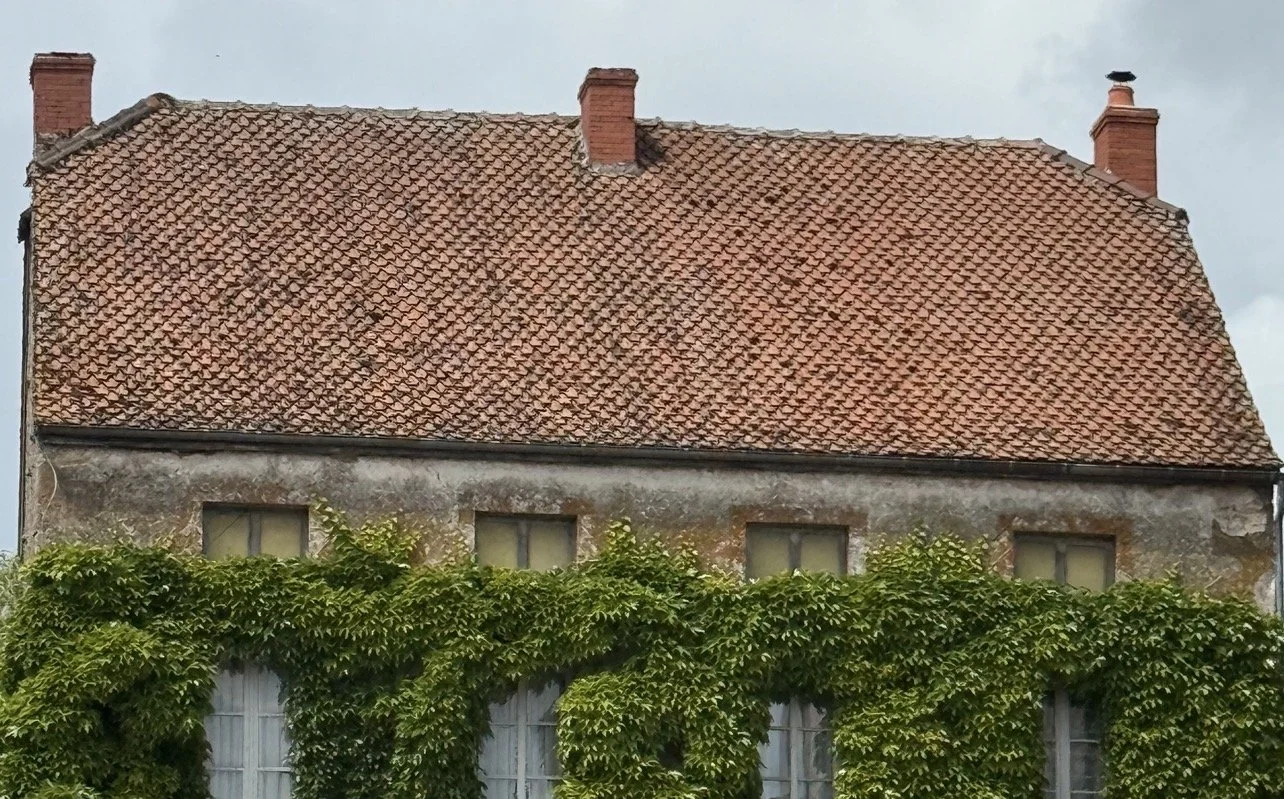
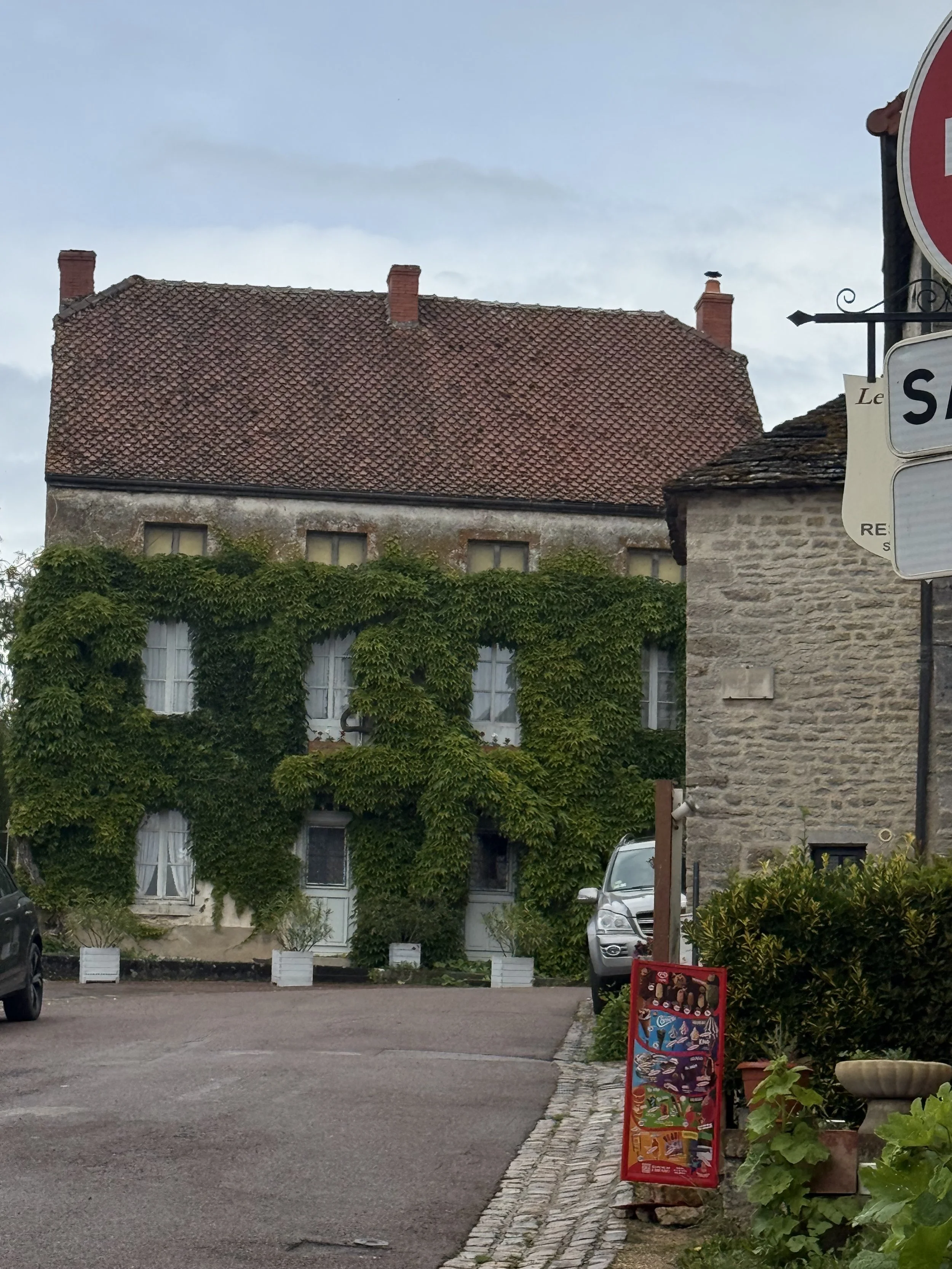
I had barely turned the corner into the village square of Châteauneuf-en-Auxois when I stopped walking. Not because of the medieval castle looming on the hilltop — though that is impressive enough — but because of a roof. A perfectly ordinary, centuries-old roof, half swallowed by ivy, sitting quietly above a stone courtyard as if it had been there forever. Which, in many ways, it had.
For travelers drawn to architecture and the bones of old buildings, Châteauneuf is not just a pretty village. It is a living classroom. And the roofline of this particular manor house is one of its most eloquent lessons.
What You're Actually Looking At
The roof in this photograph is covered in tuiles de Bourgogne — Burgundy tiles — a style of flat-ish, slightly curved clay roofing tile that has been produced in this region for well over five centuries. They are sometimes called tuiles plates (flat tiles) or tuiles à emboîtement, and they are one of the most architecturally distinctive features of rural Burgundian buildings.
Unlike the round Roman-style barrel tiles you see in Provence, or the smooth slate common in Brittany and Normandy, Burgundy tiles are laid in dense, overlapping rows — each tile interlocking with the next in a pattern that creates an almost scale-like texture when viewed from the street. The result is a surface that catches light differently at every hour of the day.
"The roof is not decoration — it is engineering. Every tile, every angle, every pitch was calculated to handle centuries of rain, frost, and snow without a single nail."
THE GEOMETRY OF SURVIVAL
Why the Pitch Matters
Notice the steep slope of this roof — that is not an aesthetic choice. It is a climate response. Burgundy sits in a continental climate zone where winters bring heavy snowfall and frequent freeze-thaw cycles. A roof pitched at roughly 45 to 55 degrees allows snow to slide off before its weight becomes structurally dangerous, and ensures that rainwater evacuates quickly, preventing moisture from working its way under the tiles.
The four-sided hipped design you see here — known in French as a toit en croupe — eliminates exposed gable ends entirely. Every face of the roof slopes down to the eaves, reducing wind vulnerability and keeping the underlying timber frame protected on all sides. Medieval builders understood physics through experience, and this roofline reflects generations of hard-won knowledge.
ARCHITECTURAL BREAKDOWN — WHAT MAKES THIS ROOF DISTINCTIVE
TILE TYPE
Tuiles de Bourgogne
Flat interlocking clay tiles, fired to a warm terracotta
ROOF FORM
Hipped Roof (Toit en Croupe)
Four sloping faces, no exposed gable ends
PITCH ANGLE
~45–55°
Steep slope designed for snow shedding and rain drainage
MATERIAL ORIGIN
Local Clay, Kiln-Fired
Historically produced within Burgundy using regional clay deposits
CHIMNEYS
Red Brick Stack
Three exposed stacks signal multiple hearths — common in manor houses
EST. AGE
17th–18th Century
Construction style consistent with Burgundian rural manor tradition
THE COLOR TELLS A STORY
That Terracotta Glow
The warm orange-red color of these tiles is not a glaze or a paint. It is the natural result of iron-rich clay being fired at high temperatures — a process that has produced virtually the same color in this region for five hundred years. Over time, exposure to weather, lichen, and moss gradually darkens and variegates the surface, giving older roofs their characteristic patchwork of amber, rust, and deep burgundy tones.
What makes the Burgundy tile distinctive from other French terracotta traditions is its relatively flat profile. While Provençal roofs use deeply curved Roman tiles that create strong shadow lines, Burgundy's flatter tile produces a more uniform, tightly woven surface — almost textile-like in its density. From a distance, the roof reads as a single warm plane. Up close, it reveals thousands of individual tiles, each one hand-formed and slightly irregular.
FIVE THINGS AN ARCHITECTURAL TRAVELER SHOULD KNOW
Burgundy tiles were historically made by hand — craftsmen pressed clay over a thigh mold, which is why older tiles have a slight curve that perfectly fits a human leg
The three chimneys on this roof indicate a prosperous household — heating multiple rooms was a luxury in pre-industrial France
The ivy covering the facade is not accidental — in many Burgundian villages, climbing plants were cultivated to insulate stone walls against winter cold
France strictly regulates roof replacements in historic villages — new tiles must match the original material, color, and profile exactly
Châteauneuf-en-Auxois is classified as one of the Plus Beaux Villages de France (Most Beautiful Villages of France) — a designation that protects its architectural character
FOR THE ARCHITECTURE TRAVELER
How to Visit With Intention
Most visitors to Châteauneuf come for the 12th-century castle. And rightly so — it is one of the best-preserved medieval fortresses in all of Burgundy, overlooking the Canal de Bourgogne and the Auxois plain with remarkable authority. But if you arrive with an eye for buildings, give yourself time to walk the village slowly, away from the castle approach.
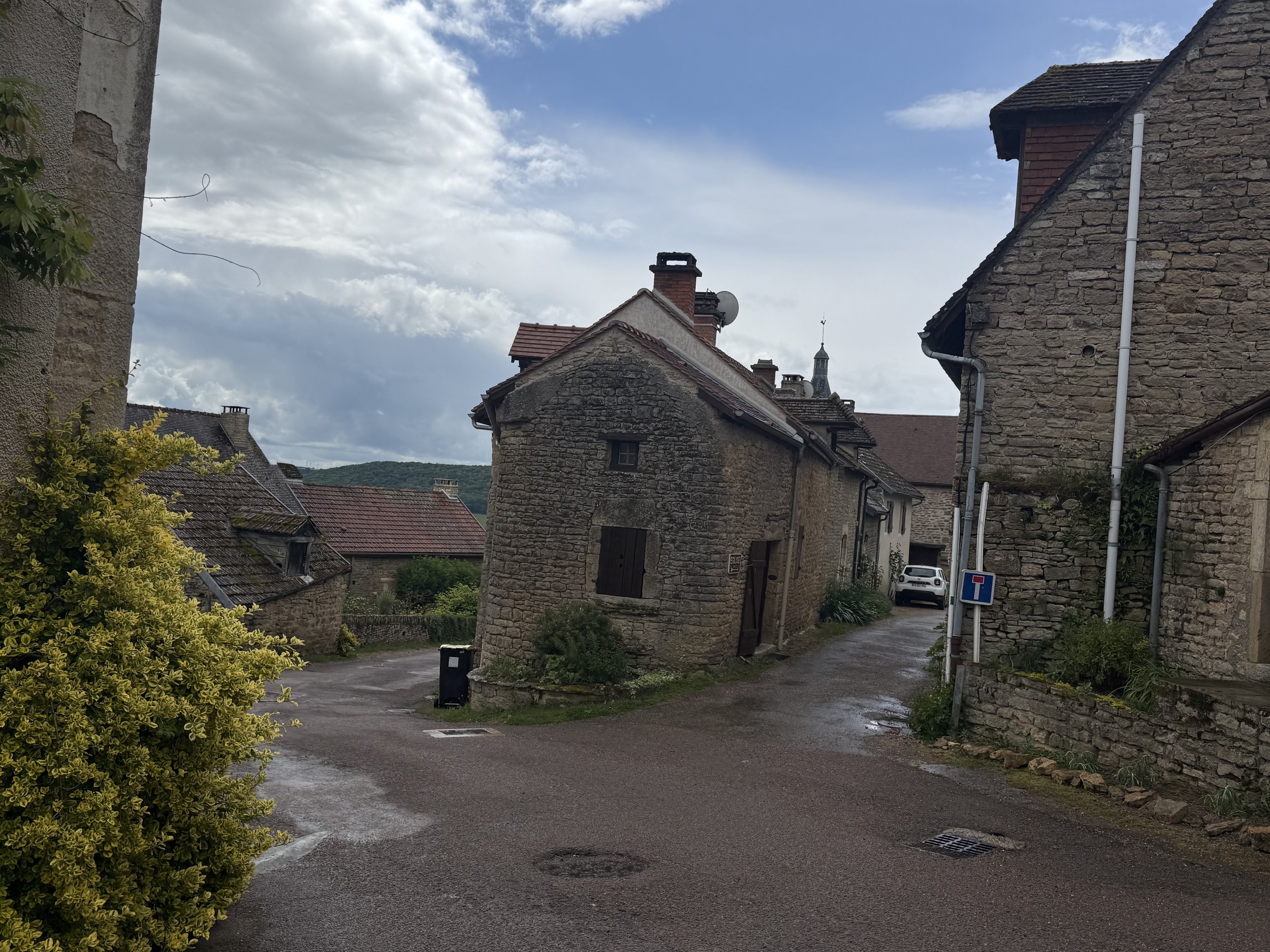
The residential streets that fan out from the central place offer some of the most consistent examples of intact Burgundian rural domestic architecture anywhere in France. Look for the variation in roof pitches from building to building — some steeply medieval, others more relaxed and 18th-century in proportion. Notice how the chimneys are positioned, how the eaves are detailed, and how the stone walls transition from rough rubble at the base to more dressed stonework around windows and door frames.
The best light for photographing the rooflines falls in the late afternoon, when low sun catches the terracotta tiles from the west and the ivy on the facades turns luminous green. The village is quiet — especially on weekday mornings — and the courtyard where this photograph was taken is accessible from the main rue. Allow at least two hours to walk the village properly, and bring a long lens if you want to capture roof detail from street level.
A Final Word on the Ivy
It would be easy to look at this building and see the ivy as picturesque — which it is. But look more carefully at how it has been trained. It follows the window lines deliberately, framing each shutter rather than obscuring it. This is intentional cultivation, not neglect. Someone, at some point, decided that this building and this plant would coexist on carefully negotiated terms. That negotiation is still visible today — in the gaps around the windows, the clear line of the roofline, the trim around the door. The building holds its shape. The ivy holds its lane. Between them, they have produced something that no architect alone could have designed.
That, perhaps, is the deepest lesson Châteauneuf has to offer — that the most beautiful buildings are never finished. They are tended.
FRANCE | BURGUNDY | ARCHITECTURE | HISTORIC VILLAGES