
The Ultimate Guide to Historic Slate, Clay Tile, and Copper Roof Preservation
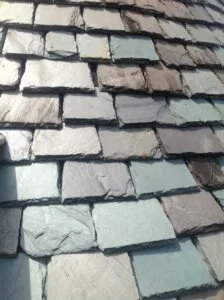
Multi-colored natural slate Roof
Preserving the Legacy of Custom Roofs
Beyond the Surface: The Art of Material Matching
When a historic slate or clay tile roof requires repair, the goal is often invisible
success. A patch that stands out can diminish the architectural integrity of the
entire structure. True preservation requires a deep understanding of the
geological and manufacturing history behind these materials.
The Nuance of Natural Slate
Not all slate is created equal. A "black slate" from a quarry in Vermont possesses
entirely different weathering characteristics than one from Buckingham,
Virginia. Some slates are "unfading," maintaining their original hue for a
century, while others are "semi-weathering," shifting into soft tans and greys
over time. Successful restoration relies on identifying the specific quarry of
origin to ensure the new pieces age in harmony with the old.
Pro Tip: When assessing a slate roof, we look for the "ribbon" or grain of the
stone. This technical detail helps us source materials that match the original
builder's intent.
The Search for Salvaged Clay
With clay tile, the challenge often lies in the profile. Many historic
manufacturers—names like Ludowici or various regional potteries—produced
unique shapes that are no longer in standard production. Sourcing these
requires a network of salvaged material specialists to find tiles that fit the
interlocking patterns of the existing roof without compromising the water-
shedding capabilities.
Expert Insights into Historic Roofing Systems
Copper: The Silent Protector
While slate and tile are the stars of the show, copper is the foundation of a roof's longevity.
It is used in the "high-stress" areas: valleys, chimneys, and dormers. Unlike modern systems
that rely on sealants, historic copper work relies on the art of the soldered joint.
A properly executed copper valley is a mechanical bond, designed to expand and contract
with the seasons for eighty years or more. When we perform a technical assessment, we
aren't just looking at the shingles—we are looking at the integrity of the metalwork that
keeps the structure dry.
Qualified Experience vs. General Labor
Historic roofs are effectively high-performance masonry systems. They cannot be treated
like modern asphalt. Walking on a clay tile or a 100-year-old slate without specialized
ladders and hooks can cause more damage than the weather itself.
When choosing a partner for your roof, look for qualified experience in:
Material Sourcing: The ability to provide exact geological or manufacturer matches.
Historic Soldering: Expertise in traditional copper-smithing techniques.
Specialized in the Preservation of Vermont Slate, Buckingham Slate, Ludowici Tile, and
Custom Copper Systems.