
Copper at its Finest
From Gold to Green
The Living Beauty of Copper
Copper Roofing · Church Steeples · Historic Preservation
Carolina Slate · Roofing & Restoration · 10 min read
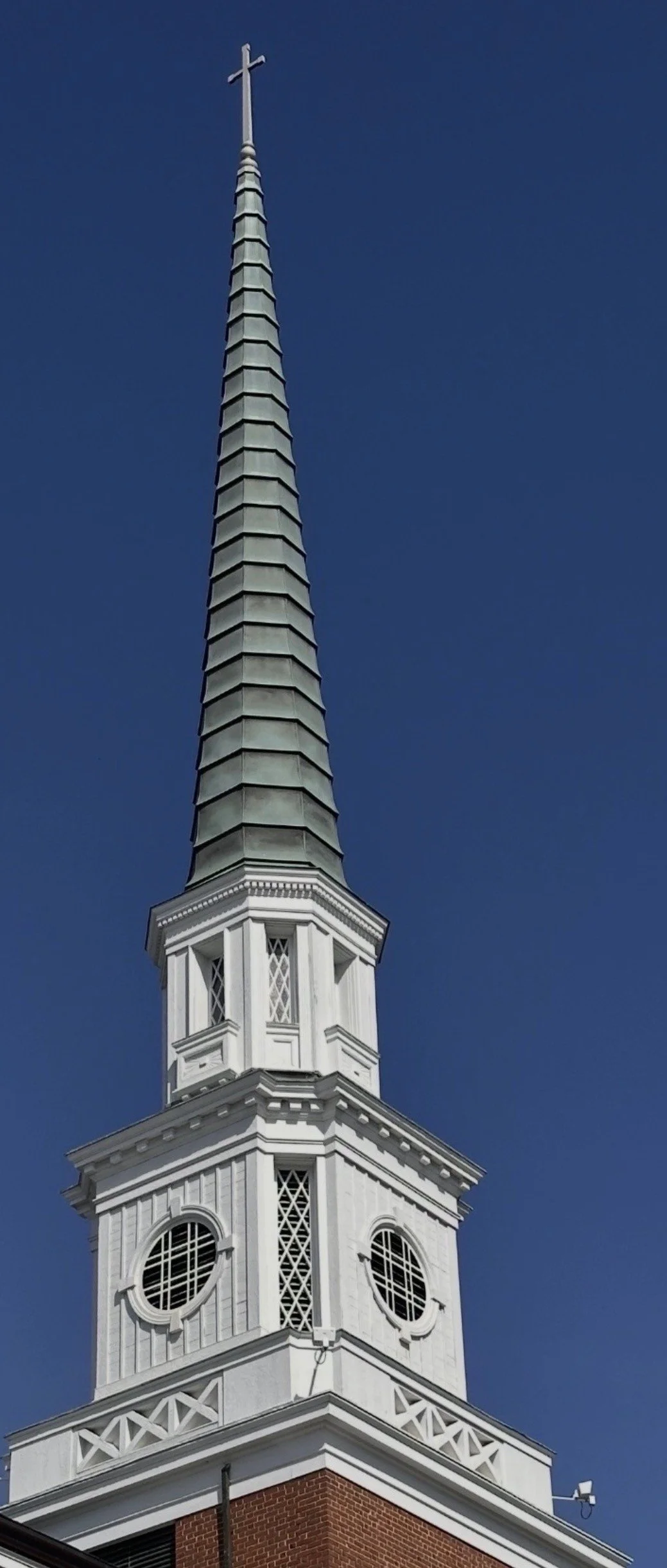
Look up at the steeple in this photograph. That quiet, sage-green sheen — layered, luminous, impossibly dignified — was not always there. The copper that now glows with centuries of earned character was once as bright and warm as a freshly minted penny, catching the sun like hammered gold. It arrived at this church young and gleaming. Over decades — with nothing more than rain, air, and time — it became something far more beautiful.
Copper is perhaps the most remarkable roofing material ever used by human hands. It is the only metal on a roof that improves with age, growing more beautiful while simultaneously becoming more protective. It tells time in color. And nowhere is that transformation more breathtaking than on the steeples and domes of historic churches across North Carolina and the American South.
Copper does not merely weather. It transforms — cycling through golds, browns, and chocolates before settling into the timeless blue-green that defines our most beloved historic skylines.
When New: Bright, Warm, and Golden
When copper is first installed on a steeple, dome, or roofline, it arrives with a warm, reddish-golden brilliance that genuinely stops people in their tracks. Fresh copper reflects sunlight in a way few materials can match — it has a living warmth that reads almost amber in morning light and rose-gold in the afternoon sun.
This initial color comes from the pure elemental nature of the metal itself. Copper (Cu) in its unoxidized state reflects light across the orange-red spectrum, which is precisely why it has been prized for ornamentation and roofing since ancient times. The Romans sheathed the Pantheon's portico in copper. Norse craftsmen topped their stave churches in it. Early American builders chose it for the most important structures they ever raised — courthouses, state capitols, and places of worship like the one in this photograph.
In its first weeks, fresh copper on a church steeple shines with a warmth so striking that neighbors often stop to look. It is one of the most dramatic roofing materials ever installed — and it only gets better.
The Patina Process: A Chemical Story in Five Acts
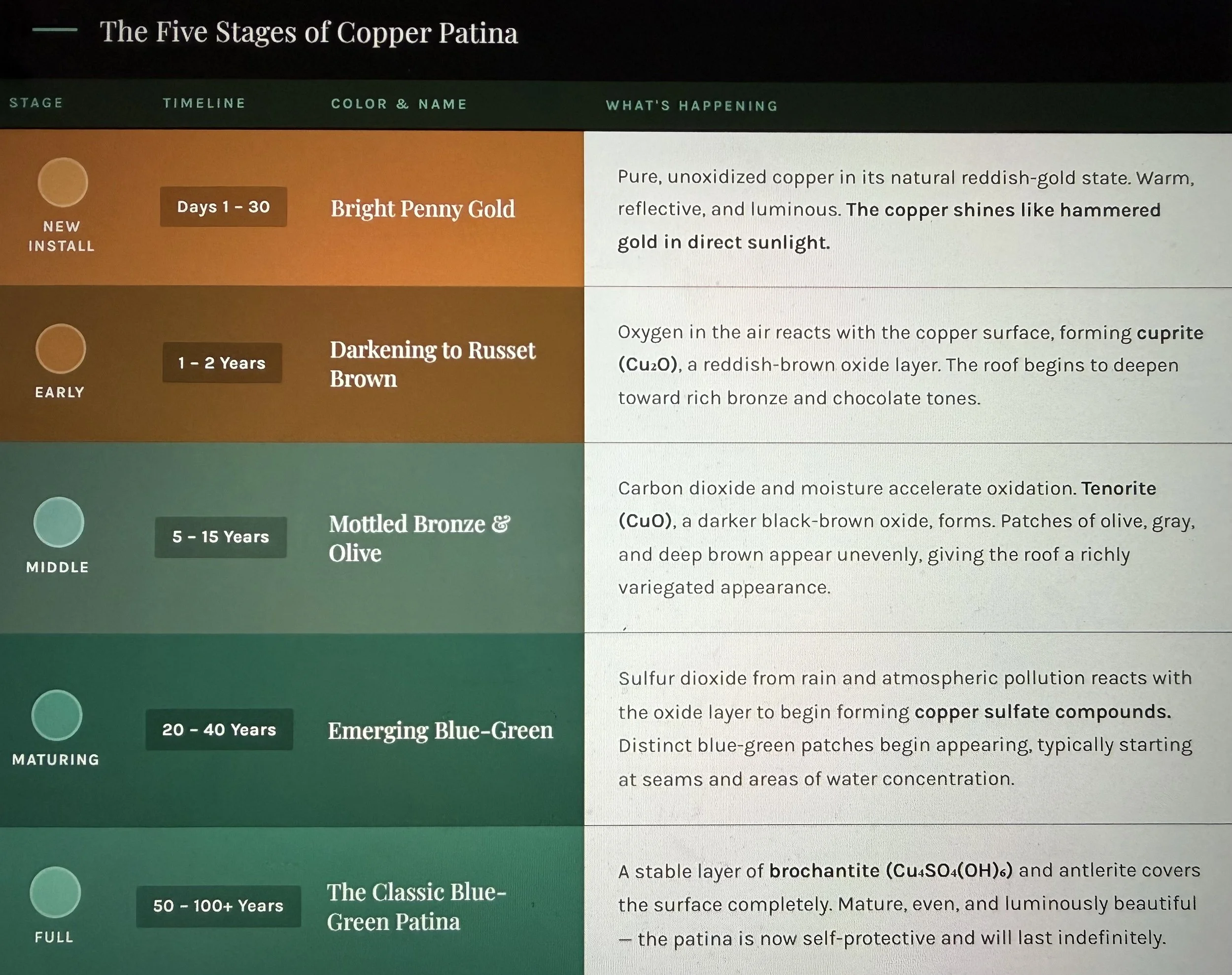
What happens to copper after installation is not decay — it is transformation. The blue-green patina that defines every beloved historic copper roof is called verdigris or, more precisely, brochantite and antlerite, complex copper sulfate compounds that form over years of exposure to the elements. The process unfolds in recognizable stages:
Copper transformation
A stable layer of brochantite (Cu₄SO₄(OH)₆) and antlerite covers the surface completely. This is the color seen on the steeple above — mature, even, and luminously beautiful. The patina is now self-protective and will last indefinitely.
The Chemistry of Patina Formation
2Cu + O₂ → 2CuO // First oxidation — dark brown cupric oxide
4Cu + O₂ → 2Cu₂O // Cuprous oxide — reddish brown
Cu₂O + CO₂ + H₂O → malachite compounds // Early green traces
4Cu + SO₂ + 3O₂ + 4H₂O → Cu₄SO₄(OH)₆ // Brochantite — the classic patina
The final patina layer is chemically stable and adherent — it does not flake, peel, or continue reacting. It forms a mineralic armor that actually protects the copper beneath from any further corrosion.
Durability & Longevity: Centuries, Not Decades
If copper's visual transformation is remarkable, its longevity is frankly extraordinary. While asphalt shingles last 20–30 years, and modern metal panels may promise 50, copper roofing systems installed by skilled craftsmen routinely last 100 to 200 years — and in protected conditions, even longer.
The fully developed patina is not just beautiful — it is among the most durable protective coatings in the natural world. Once the brochantite layer stabilizes (typically after 50–80 years), the copper beneath it will essentially never corrode further under normal atmospheric conditions. The roof becomes, in the truest sense, self-maintaining.
200+ Year lifespan (documented)
0.001" Material lost per year to corrosion
1 lb Per square foot — extremely lightweight
100% Recyclable at end of life
Why Copper Outperforms Every Alternative on Historic Buildings
On a church steeple — perhaps the most exposed, most punished roofing surface in any building — copper's advantages compound. It expands and contracts with temperature without cracking, splitting, or delaminating. It is immune to the ultraviolet degradation that destroys synthetic materials. It sheds water without seams or fasteners that can fail. And critically, it requires no painting, no coating, no maintenance beyond the occasional copper nail replacement after a storm.
The steeple in this photograph is a perfect example. The base of the structure — the white painted tower with its round oculus windows — will require repainting every 7–10 years. The brick below will need tuck-pointing over time. But the copper spire above? It will outlast every other material on the building. It may well outlast the generation of craftsmen who install the next repair.
Remarkable Facts About Copper
Beyond roofing, copper is one of the most extraordinary materials in human history. Some facts worth knowing:
One of humanity's oldest metals. Copper has been worked by humans for more than 10,000 years — predating bronze, iron, and steel. The first known copper artifacts date to 8700 BCE in what is now Iraq.
Naturally antimicrobial. Copper kills bacteria, viruses, and fungi on contact through a process called the oligodynamic effect. This is why copper has historically been used in hospitals and why copper drinking vessels have been used for millennia in cultures worldwide.
The Statue of Liberty is copper. Her famous green color is exactly the same patina process seen on this steeple — 62,000 pounds of copper sheets that went from bright penny-gold at installation in 1886 to their current blue-green by approximately 1920.
Essential to all life. Copper is a trace element required by every living organism. It is present in human blood, enabling oxygen transport and enzyme function.
Infinitely recyclable. Copper never degrades when recycled. Approximately 80% of all copper ever mined is still in use today. A copper roof removed from a building after 150 years retains its full material value and can be recycled without any loss of quality.
The best conductor after silver. Copper conducts electricity better than any metal except silver — which is why virtually all wiring on Earth is copper. Its thermal conductivity is equally exceptional, making it ideal for roofing flashings where differential expansion is a challenge.
Self-sealing at joints. Over time, patina and natural movement cause copper seams and joints to become increasingly watertight without any sealant. Well-executed copper standing seams on a church roof can become virtually impermeable over decades.
Historic American landmarks clad in copper. The Capitol dome in Washington D.C., Trinity Church in Boston, St. Patrick's Cathedral in New York, and hundreds of state capitols and courthouses across America are all sheathed in copper roofing.
Lightest long-term metal roofing. At roughly 1–1.5 lbs per square foot for 16 oz copper, it adds minimal structural load — critical on historic church structures not designed for heavy modern roofing materials.
Compatible with slate. Copper and natural slate are the traditional roofing pairing for precisely this reason: both last 100+ years, both are fully recyclable, and copper's natural expansion coefficient is compatible with slate's rigidity without causing cracking or displacement over time.
Copper on Church Steeples: A Spiritual & Architectural Choice
There is a reason the builders of this church — and of so many historic churches across North Carolina — chose copper for the steeple and not a cheaper material. A steeple is the most visible part of a church. It is meant to be seen from a distance, to stand above the town, and to endure. Copper was the material that could make that promise honestly.
The transformation from gold to green also carries a kind of meaning that was not lost on the craftsmen and congregations of earlier centuries. A new copper steeple announced arrival — bright, gleaming, proud. An old copper steeple, green with age, announced permanence. It said: we were here long before you, and we will be here long after.
The steeple in this photograph is not decaying. It is not aged in the sense of weakness or decline. It is, in the truest sense, still becoming — still finishing the century-long transformation that began the day the first sheet of copper was soldered into place. It will look like this, or more beautiful still, long after every asphalt shingle in the county has been replaced twice over.
At Carolina Slate, copper is not an add-on or an upgrade. It is the standard. Every slate roof we install or restore uses copper nails, copper flashings, copper valleys, and copper gutters — because anything less creates the weakest link in a system built to last generations. When a church calls us about their steeple, we speak the same language their original builders spoke: natural materials, traditional methods, permanent results.
If your church, historic home, or landmark building has a copper roof or steeple in need of assessment, repair, or full restoration — we'd be honored to hear from you.
Carolina Slate · Chapel Hill, NC & Beyond
Does Your Church or Historic Building Have Copper Roofing?
We specialize in copper steeple repair, flashing restoration, and historic church roofing across North Carolina and Georgia.